
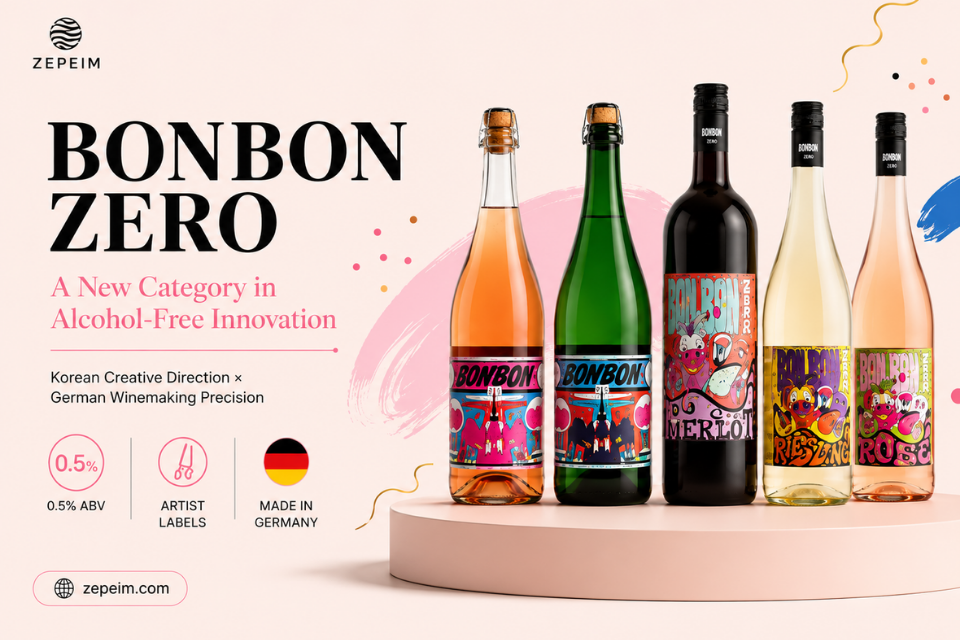
Bonbón Drinks: A New Category in Alcohol-Free Beverage Innovation
On a Friday evening at a design-forward Manhattan hotel, a guest checked in jet-lagged from Seoul and made her way to the rooftop bar before she even unpacked. The bartender placed a chilled glass in front of her, then turned the bottle so she could see the label — a riot of color, bold cartoon strokes, signed by an artist she happened to follow on Instagram. She pulled out her phone before her first sip. That photograph reached 14,000 people overnight. The bottle in question was BONBON Zero Sparkling Rosé — a non-alcoholic wine that is not trying to replace the drink in your hand. It is trying to replace what that drink means. This is the emerging logic of a new category in alcohol-free beverage innovation: wine that is desirable not because it imitates something else, but because it stands as its own object.
Executive Summary
Launched in 2025 by Winevision Tech & Design, BONBON Zero represents the clearest articulation yet of a new direction in the non-alcoholic beverage industry. Where most non-alcoholic wines have positioned themselves as careful substitutes for the alcoholic original — copying the bottle shape, the label format, the wine vocabulary — BONBON does something fundamentally different. It pairs serious German winemaking craft with Korean creative direction, then commissions internationally recognized artists like Hattie Stewart and José Miguel Méndez to design the labels.
The result is a category-defining product line — five expressions spanning Riesling, Merlot, Rosé, Blanc de Blancs, and Sparkling Rosé — that functions equally well in fine-dining beverage programs, design-led hospitality concepts, and lifestyle retail. For Zepeim partners, BONBON Zero opens an entirely new conversation with buyers who think about beverages as part of a guest experience, a brand statement, or a retail moment — not merely as a substitute for something else.
Why a New Category Was Inevitable
For most of the last decade, the non-alcoholic wine market has been organized around a single argument: this tastes like the real thing. Producers competed on dealcoholization technique, on grape provenance, on how closely the finished product replicated a familiar wine. That argument has won real ground — consumers now expect serious quality from premium 0.0% and <0.5% wines. But it has also produced a generation of products that look, on the shelf, more or less the same.
The next move was inevitable. Once the technical floor was established, producers needed to ask a different question: not "how do we copy wine?" but "what role does a non-alcoholic beverage play in a guest's experience, a retail moment, a social occasion?" BONBON's answer — that the beverage itself should be visually compelling, culturally relevant, and worth being seen with — is the foundational move of a new category that sits at the intersection of gastronomy, design, and mindful drinking.
|
2025
Brand Launch Year
|
5 SKUs
Full Wine Range
|
26 kcal
Per 150ml Pour
|
This pivot matters most in the spaces where non-alcoholic wine has historically struggled — design-forward hotels, modern hospitality groups, concept stores, and the kind of accounts whose buyers also care about typography, music programming, and the look of their service tableware. For those operators, BONBON is the first non-alcoholic wine that feels like part of the curation rather than an apology bolted onto it.
How Design-Forward Hospitality Is Already Responding
Beverage directors at lifestyle hotels, chef-driven restaurants, and concept-led venues have been quietly looking for this category for years. The signs were everywhere: cocktail menus that began as printed booklets in custom typography, glassware curated like art, music programs treated with the same care as the wine list. The non-alcoholic section, by contrast, often remained the weakest link — a perfunctory pour, a generic substitute, a missed opportunity to extend the same curation logic to the entire guest experience.
BONBON closes that gap. The product carries enough visual weight to stand alongside the cocktail menu's hero image. A bottle facing forward on a bar back becomes a conversation piece. A pour at a guest's table becomes a moment of "what is that?" rather than "what's the substitute?" For operators who understand that hospitality is partly performance, that shift is significant.
The same pattern is showing up in premium retail. Concept stores and curated lifestyle shops that have struggled to merchandise non-alcoholic wine — because the category historically didn't carry shelf presence — are finding that BONBON fits naturally into windows alongside design objects, niche fragrances, and limited-edition print runs. The product earns shelf space because the bottle itself is a point of attraction.
Strategic Importance: Production Substance Behind the Design
A category built on visual identity alone would collapse under the first sommelier tasting. BONBON Zero's design ambition is matched by genuine production substance, which is what makes the brand a credible long-term addition to a beverage program rather than a one-season trend.
The wines are produced in Germany using high-quality grapes and an advanced low-temperature dealcoholization process. This method matters technically — gentle alcohol removal at low temperatures preserves the structural elements that define varietal character: aromatic compounds, acidity balance, tannin structure in the reds, and the fine mousse in the sparklings. The wines clock in around 26 to 30 calories per 150ml serving with clean ingredient lists, putting them in the wellness-conscious territory that mindful-drinking guests increasingly expect.
The dual logic of BONBON: German winemaking precision answers the sommelier's technical question — does this wine hold its varietal character through dealcoholization? Korean creative direction answers the buyer's strategic question — does this product earn its place on a curated menu or shelf? Most non-alcoholic wines answer one of those questions well. BONBON is built to answer both.
For Zepeim partners building Reserve-level beverage programs, BONBON Zero functions as a category-expander. It sits comfortably alongside established premium European brands in the Zepeim portfolio — French Bloom, Pierre Chavin, Kolonne Null, Lussory — while opening doors to accounts that prioritize lifestyle and design as decision factors. For curated retail, it solves the shelf-presence problem that has long limited non-alcoholic wine in premium environments.
The BONBON Zero Range
The full BONBON Zero lineup spans five expressions — Sparkling Rosé, Blanc de Blancs, Rosé, Riesling, and Merlot — each at 0.5% ABV, vegan-friendly, and produced in 750mL bottles with artist-designed labels. Featured below are three representative selections covering sparkling, still white, and still red service categories.
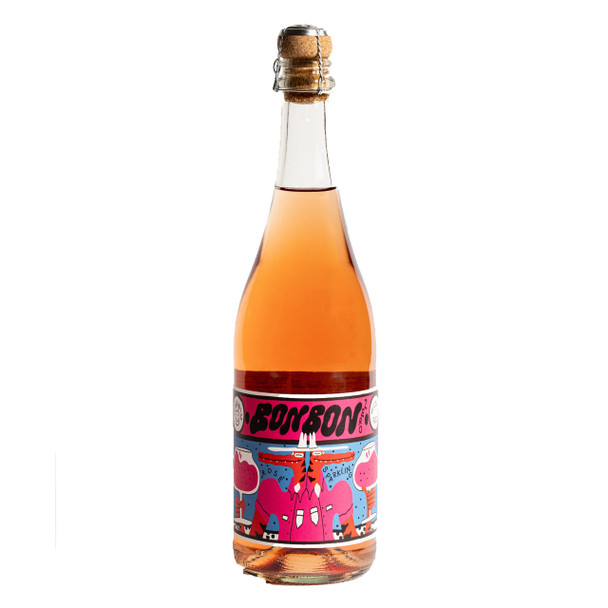 |
0.5% ABV · Vegan · Tempranillo
BONBON Zero Sparkling RoséA premium non-alcoholic sparkling rosé crafted from dealcoholized Tempranillo. Expressive aromas of strawberry, raspberry, and rose petals lead to bright red-fruit flavor with fine bubbles and a refreshing, slightly rounded finish. Just 26 calories per 150ml. Ideal for: Rooftop bar service, brunch and aperitif programs, lifestyle retail, celebrations and toasting moments where the bottle itself becomes part of the occasion. View Product → |
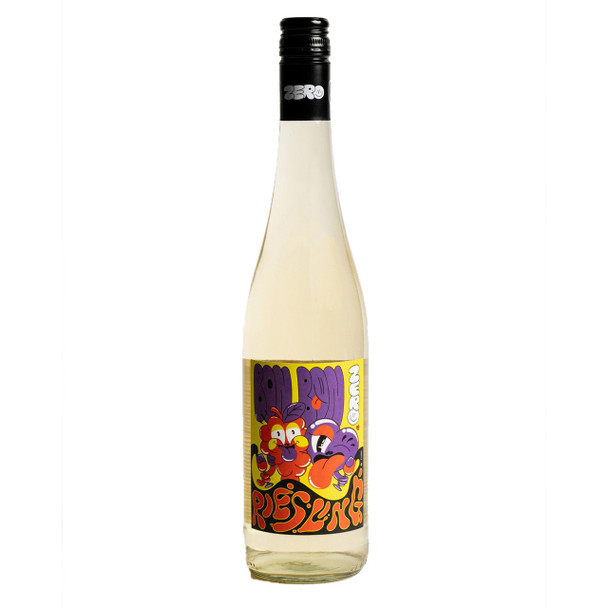 |
0.5% ABV · Vegan · Riesling
BONBON Zero RieslingA non-alcoholic Riesling produced from authentic German grapes with the variety's signature crisp acidity intact. Bright aromas of lemon, pear, and white peach lead to layered citrus and stone fruit notes with a clean, refreshing finish — built for food pairing, not for sweetness. Ideal for: Chef-driven menus, Asian and pan-Asian cuisine programs, seafood-forward dishes, Michelin-level pairing programs where structure matters more than approximation. View Product → |
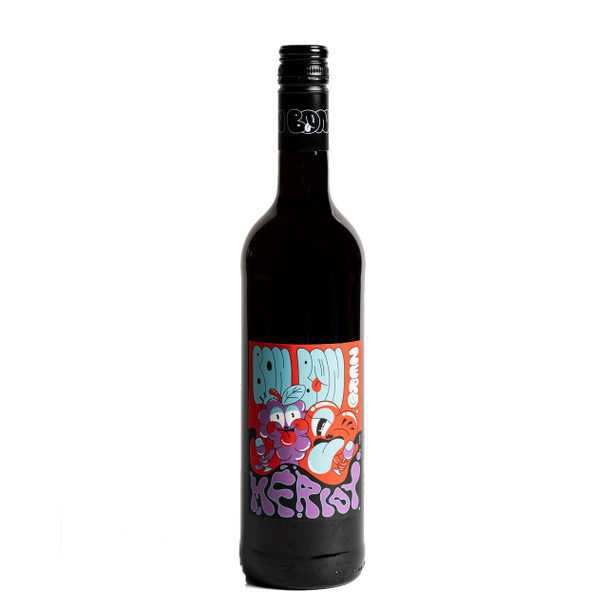 |
0.5% ABV · Vegan · Merlot
BONBON Zero MerlotA non-alcoholic red wine with the structural backbone expected from a true Merlot. Rich aromas of black cherry, blackcurrant, and dried plum lead to a smooth, medium-bodied palate with soft tannins and balanced dark fruit. Serves slightly chilled at 16–18°C. Ideal for: Grilled meats, pasta and ragù dishes, aged cheese service, hearty winter menus, restaurants seeking a non-alcoholic red with genuine tannin presence. View Product → |
The full range also includes BONBON Zero Rosé (still, Tempranillo) and BONBON Zero Blanc de Blancs (sparkling Chardonnay). All five expressions are available for wholesale through Zepeim.
Revenue, Margin, and the Premium Positioning Advantage
BONBON Zero is priced and positioned as a premium non-alcoholic wine, with MSRPs of $30–$32 per bottle at retail. For hospitality operators, this opens by-the-glass pricing in the $15–$20 range — territory previously reserved for mid-to-upper-tier alcoholic wines. For retailers, the bottle's design-as-merchandise quality drives a higher impulse-purchase rate and unlocks gift-giving and lifestyle-store distribution channels that lower-priced non-alcoholic wines rarely access.
The financial logic is straightforward: a guest who would have ordered a $6 mocktail, sparkling water, or generic non-alcoholic alternative now orders an $18 glass of BONBON Sparkling Rosé. That difference compounds across covers, across nights, across the year — without adding labor, training overhead, or back-of-house complexity.
Zepeim Wholesale Discount Structure
5% off — orders of 12+ cases (mix and match any brands)
7.5% off — orders of 36+ cases
Free shipping — orders over $350 anywhere in the continental U.S.
Fast fulfillment — ships within 1 business day from Zepeim's Los Angeles warehouse, nationwide including Hawaii
Because Zepeim's volume discounts can be combined across the full curated portfolio, buyers can launch BONBON Zero alongside complementary Reserve-tier brands — building a complete premium non-alcoholic wine program at meaningful case-pricing efficiency without committing to deep inventory in any single SKU.
The Guest Who Orders BONBON
The customer for design-led non-alcoholic wine is not the customer most operators imagine when they hear "non-alcoholic." This guest is rarely abstinent for moral or medical reasons. More often, they are choosing — actively and selectively — when to drink and what to drink, and they want their non-alcoholic order to feel like a continuation of their identity, not a step down from it.
This profile skews younger, more urban, more design-conscious, and more digitally engaged. They post their drinks. They notice the typography on the bottle. They are the demographic driving the broader "mindful drinking" movement that has reshaped beverage programs from Brooklyn to Seoul to Berlin. They are also, increasingly, the buying decision-makers at hospitality groups, hotel brands, and concept retail — meaning the brand's appeal compounds: it sells to them as guests, and it gets stocked by them as operators.
For Zepeim partners, this audience represents the leading edge of premium non-alcoholic demand. The guests who order BONBON today are often the same guests who, three years from now, will expect every premium establishment they visit to offer a non-alcoholic program of the same caliber as the wine list. Building that program around a design-forward anchor like BONBON sends an early signal to that audience that an operator is paying attention.
A Launch Roadmap for Operators and Retailers
BONBON Zero rewards a specific kind of launch — one that treats the brand as a lifestyle product, not a substitute SKU. The four-phase approach below has worked for the early adopters Zepeim has worked with across hospitality and premium retail.
| Phase | Timeline | Focus |
|---|---|---|
| 1. Visual Audit | Week 1 | Order the full BONBON range. Look at the bottles in your actual service environment — bar back, retail shelf, table presentation. Identify the SKUs that align most strongly with your venue's existing design language. |
| 2. Menu/Display Placement | Weeks 2–3 | For restaurants: position BONBON within the main wine list with a clear non-alcoholic designation — not in a separate back-page section. For retail: place bottles at eye level in design-led adjacencies, not in a generic non-alcoholic ghetto. |
| 3. Staff & Story | Weeks 3–4 | Train teams on the brand narrative — Korean creative direction, German production, artist label collaborations, low-temperature dealcoholization. This story sells the bottle as much as the liquid does. |
| 4. Lifestyle Amplification | Weeks 5–8 | Feature BONBON in social content, in-house events, and seasonal programming. The bottle is built to be photographed — let it do that work. Measure attach rate, by-the-glass velocity, and guest social impressions. |
The Category Has Moved — and BONBON Is the Signal
For nearly a decade, premium non-alcoholic wine has been working to prove it deserves a seat at the table. That argument has been won. The next chapter is no longer about justification — it is about identity. What does a non-alcoholic wine look like when it stops apologizing for what it isn't and starts insisting on what it is? BONBON Zero is the cleanest answer that question has received so far.
For restaurants, hotels, retailers, and distributors thinking about where the non-alcoholic category goes next, BONBON Zero is worth carrying not only for what it adds to the menu today, but for what it signals to the guests, buyers, and operators of the next five years. Through Zepeim — the U.S.'s most established non-alcoholic beverage importer since 2016 — the full BONBON Zero range is available nationwide, with the curatorial support and operator training that have defined the Zepeim approach since the brand's earliest days.
Bring BONBON Zero Into Your Program
Zepeim is the U.S. distributor of BONBON Zero, with the full five-SKU range available for wholesale order. Ships within one business day from Los Angeles. Nationwide delivery including Hawaii. Volume discounts apply across the curated Zepeim portfolio.
Apply for a Wholesale Account →Frequently Asked Questions
Recent Posts
-
Hidden Gems: Zero-Proof Champagne Alternatives
A senior wedding planner at a Manhattan events firm spent a January morning reviewing the previous …Aug 1st 2026 -
Exploring the World of Non-Alcoholic Aperitifs
The beverage manager of a boutique hotel in Boston's Back Bay walked her weekend team through the …Jul 29th 2026 -
Non-Alcoholic Cocktail Programs for Bars
The head bartender of a 40-seat cocktail bar in downtown Portland kept a paper notebook behind the …Jul 26th 2026