
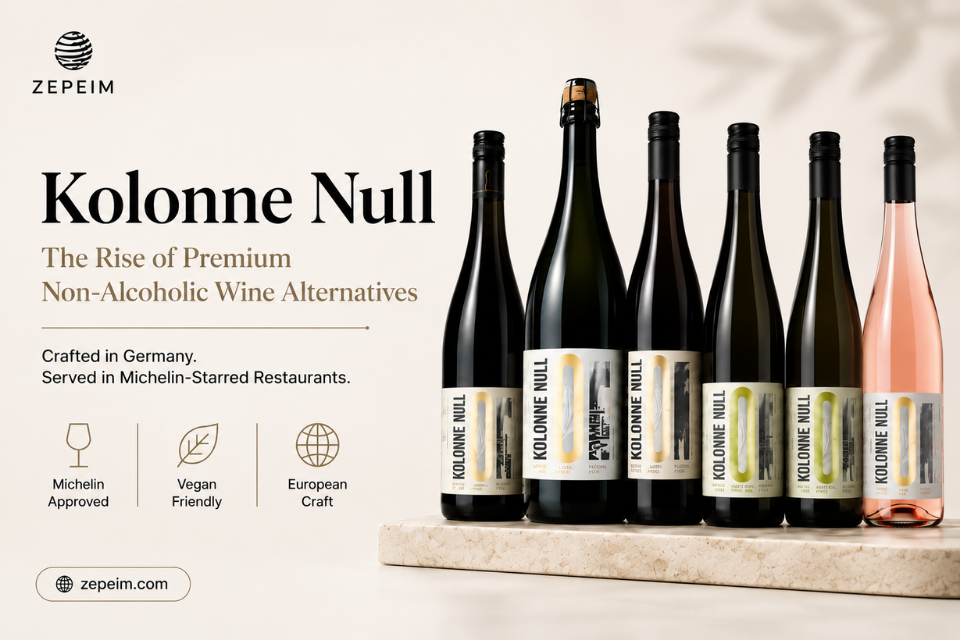
Kolonne Null and the Rise of Premium Non-Alcoholic Wine Alternatives
A beverage director at a Michelin-starred restaurant in New York recently made a decision that would have seemed radical five years ago. She removed the house sparkling water from the aperitif service and replaced it with a non-alcoholic sparkling wine. Not as an afterthought. Not tucked at the bottom of the drinks list. She gave it a proper pour, a proper glass, and a proper introduction. The brand she chose was Kolonne Null.
That decision reflects something much larger happening across premium dining and hospitality in the United States — and Zepeim, the brand’s exclusive U.S. importer and distributor, is at the center of bringing it to market.
Executive Summary
Founded in Germany in 2018 by Philipp Roble, Kolonne Null has rapidly established itself as one of the world’s most credible premium non-alcoholic wine brands. Its products are found in Michelin-starred restaurants, luxury hotels, and high-end retail environments globally — a placement record that speaks not to marketing spend, but to product quality that wine professionals genuinely respect.
In the United States, Kolonne Null is imported and distributed exclusively through Zepeim — the country’s most established non-alcoholic importer, operating since 2016. This partnership brings one of Europe’s finest zero-proof wine portfolios to American restaurants, hotels, and specialty retailers through a distribution partner that understands the category as deeply as the brand itself.
|
2018
Founded in Germany — one of Europe’s earliest premium non-alc wine specialists
|
11+
SKUs available through Zepeim — red, white, rosé, sparkling, and magnum formats
|
<0.5%
ABV across the entire Kolonne Null range — crafted for mindful, modern dining
|
The Premium Non-Alcoholic Wine Segment Is Growing at the Top
The non-alcoholic beverage market is not a single category — it is a spectrum. At one end sits mainstream, mass-market alternatives that compete on price. At the other sits a smaller, faster-growing, and far more profitable segment: premium non-alcoholic wine, where consumers and hospitality buyers are making decisions based on provenance, production method, varietal authenticity, and brand story.
This is the segment Kolonne Null was built for. And it is precisely this segment that is growing fastest in the U.S. market. American consumers who are moderating their alcohol intake are not abandoning the wine ritual — they are seeking versions of it that meet the same quality standard as the traditional wine they’ve chosen to step back from. For those consumers, a generic non-alcoholic sparkling from an unknown source is not the answer. A structured, beautifully crafted German cuvée from a winemaker-backed brand absolutely is.
Market shift: Across the premium hotel and fine dining segment, beverage managers are no longer asking “Should we stock a non-alcoholic wine?” They are asking “Which non-alcoholic wine is worthy of our wine list?” That question has a very short list of answers — and Kolonne Null is consistently on it.
Fine Dining and Luxury Hotels Are Redefining the Non-Alcoholic Standard
The credibility of any wine brand is validated by the company it keeps. Kolonne Null has deliberately targeted the most discerning accounts in the hospitality industry — Michelin-starred restaurants, five-star hotels, and premium retail — and earned its place on those lists through flavor, not positioning. That strategy has created a virtuous cycle: when a guest encounters Kolonne Null at a Michelin-level restaurant, they seek it out elsewhere. When a hotel sommelier sees it performing well in a competitor’s beverage program, they investigate.
Three structural changes are driving this shift across U.S. hospitality:
- Wine-list integration, not a side note: Progressive beverage programs are treating non-alcoholic wines as a parallel category — listed alongside their alcoholic counterparts by style (sparkling, white, rosé, red), not segregated under “alternatives.” Kolonne Null’s range is specifically designed for this format.
- Sommelier-led recommendation: Non-alcoholic wines are increasingly being recommended by sommeliers rather than merely listed. This requires a product with enough depth to discuss — provenance, grape variety, production method, pairing logic. Kolonne Null’s European winery partnerships and varietal-specific lineup gives sommeliers exactly that.
- Event and banquet programming: Luxury hotels managing large-scale corporate events, weddings, and galas are building non-alcoholic wine service into their default catering packages — not as a special accommodation, but as a standard offering. Kolonne Null’s magnum format and consistent case availability through Zepeim makes high-volume event service practical.
Why Kolonne Null Is a Strategic Asset for Your Beverage Program
Stocking Kolonne Null is not simply adding another product to a menu. It is a signal about the level at which your operation competes. Here is why that matters strategically:
- It performs in food pairing: Kolonne Null wines are built around acidity, structure, and varietal authenticity — the qualities that make a wine work with food. Unlike many non-alcoholic options that taste best in isolation, the Riesling, Rouge No. 2, and Cuvée Blanc No. 1 are engineered to complement dishes at a high level.
- It elevates your brand association: As one of the most established non-alcoholic importers in the United States since 2016, Zepeim curates only brands that meet the standard of Michelin, luxury hotels, and premium retail. Carrying Kolonne Null places your program in that company.
- It gives sommeliers something to talk about: German craftsmanship, European winery partnerships, varietal-specific cuvées, and a brand story rooted in genuine wine culture — these are narrative assets for service staff that justify a premium positioning and support confident recommendation.
- It opens the wellness and mindful dining segment: Health-conscious professionals, sober-curious guests, designated drivers, pregnant guests, and those with medical or religious restrictions are all reached by a premium offering like Kolonne Null. These guests return to venues that accommodate them with genuine care.
The Kolonne Null Portfolio: European Craft in Every Format
What sets Kolonne Null apart from most non-alcoholic wine brands is its commitment to varietal specificity. Rather than producing a generic “white” or “red,” each Kolonne Null expression is crafted from a named grape or blend — Riesling, Syrah, Tempranillo, Merlot, Cabernet Sauvignon — and the production process is designed to preserve what makes each varietal distinctive. This gives operators a range that mirrors the logic of a traditional wine list.

Kolonne Null Cuvée N°01 Sparkling Non-Alcoholic Wine (Case-6)
The anchor of the Kolonne Null sparkling range. Crafted in Germany from carefully selected European grapes and gently dealcoholized, the Cuvée Blanc No. 1 delivers fine, persistent bubbles with aromas of pear, mirabelle, and subtle brioche. The palate is layered, creamy, and elegant — a sparkling wine experience that belongs on a serious aperitif menu, not just the “alternatives” list.
Ideal for: Aperitif service · Celebration toasts · By-the-glass sparkling program · Tasting menu welcome pour
View Kolonne Null Cuvée N°01 Sparkling →
Kolonne Null Cuvée N°02 Rouge Non-Alcoholic Red Wine (Case-6)
A structured, dry-leaning still red crafted from Syrah and Tempranillo grapes in Spain, developed in collaboration with European partner wineries and gently dealcoholized. Aromas of cherry, red currant, and cocoa open to a palate of layered red berry, plum, and subtle spice. The finish is clean, mineral-driven, and genuinely dry — making it one of the most food-capable non-alcoholic reds available in the U.S. market.
Ideal for: Red wine pairing menus · Tomato-based pasta courses · Roasted meat accompaniment · Guests seeking a dry, structured red alternative
View Kolonne Null Cuvée N°02 Rouge →
Kolonne Null White Riesling Non-Alcoholic Wine (Case-6)
Crafted from 100% Riesling grapes grown in Germany and produced in collaboration with regional wineries, this is a textbook example of what non-alcoholic white wine can achieve. Green apple, citrus zest, and crisp minerality on the nose. The palate delivers lime, orchard fruit, and pronounced acidity — dry-leaning, food-driven, and completely wine-native in its character. One of the best white wine pairings in the zero-proof category.
Ideal for: Seafood and sushi courses · Spicy dish pairing · Aperitif service · By-the-glass white wine programs
View Kolonne Null Riesling →
Kolonne Null Rosé Non-Alcoholic Wine (Case-6)
A refined still rosé crafted from a Southern French-style blend of Carignan, Cinsault, Garnacha, and Syrah — the exact grape varieties that define Provençal rosé tradition — and gently dealcoholized to preserve freshness, mineral tension, and clean fruit expression. Wild strawberry, red currant, and rose petal on the nose; a silky, dry-leaning palate with pink grapefruit and subtle minerality. This is a rosé with a genuine pedigree.
Ideal for: Aperitif and terrace service · Seafood and salad pairing · Lunch and brunch programs · Warm-weather event service
View Kolonne Null Rosé →View the complete Kolonne Null range — including the Cuvée N°03 Rouge (Merlot & Cabernet Sauvignon), Verdejo, Sauvignon Blanc, Rosé Sparkling, and the Cuvée N°01 Sparkling Magnum (1.5L) — at zepeim.com/kolonne-null-germany.
VI. Financial / Revenue ImpactRevenue Impact: Premium Positioning Means Premium Returns
Kolonne Null’s MSRP of $28–$30 per bottle positions it firmly in the premium non-alcoholic wine tier — comparable to a $30–$35 bottle of quality European white or rosé on retail shelves. For hospitality operators, this creates a favorable margin environment when priced appropriately by the glass or as part of a pairing menu.
- By-the-glass pricing: At $15–$22 per glass depending on venue tier, Kolonne Null fits naturally alongside craft wine and premium beverage pricing — far above the “soft drink” pricing trap that erodes non-alcoholic program revenue.
- Tasting menu pairing: A multi-course zero-proof wine pairing featuring Kolonne Null’s Riesling, Rouge No. 2, and Cuvée Blanc No. 1 can be positioned at $55–$75 per person — a meaningful addition to per-cover revenue without requiring additional kitchen investment.
- Event and banquet volume: The Cuvée N°01 Sparkling Magnum (1.5L) is a particularly strong event SKU — offering the visual drama of a magnum pour at a premium non-alcoholic price point that still delivers strong operator economics.
- Lower waste, longer shelf life: Dealcoholized wines maintain stability longer post-opening than traditional wines, reducing spoilage waste that typically erodes by-the-glass program margins.
Wholesale discount structure: Zepeim offers 5% off on orders of 12+ cases and 7.5% off on 36+ cases, with free shipping on orders over $350 across the continental U.S. Orders are typically processed and shipped within 1 business day from Zepeim’s Los Angeles warehouse. Apply for a wholesale account to access trade pricing.
Who Is Ordering Kolonne Null — and What They Expect
The Kolonne Null guest is, first and foremost, a wine guest. They are not ordering non-alcoholic wine because they don’t know what else to choose — they are ordering it because they understand wine and have chosen to drink less of it, or none at all. They will notice acidity structure. They will notice whether the finish lingers. They will notice if the pairing makes sense with the dish. Kolonne Null was made for this guest.
- The wine-educated moderator: Someone who has drunk good wine for years and is now choosing to reduce intake — but refuses to settle for lesser alternatives. This guest orders Kolonne Null because it tastes like a wine decision, not a concession.
- The wellness-focused professional: The guest who tracks their biometrics, travels for business, and makes deliberate choices about what they consume. For this guest, a structured, low-calorie, vegan-friendly option like Kolonne Null Riesling is a direct alignment with their lifestyle values.
- The sober-curious diner: Increasingly common across major U.S. cities — guests who may drink on occasion but are choosing not to tonight. They want the ceremony of wine service, the conversation around it, and the food pairing structure. Kolonne Null delivers all three.
- The group table non-drinker: Whether due to pregnancy, medication, religious observance, or personal choice, one guest at every table who doesn’t drink alcohol can define whether a venue feels inclusive or not. When that guest is served Kolonne Null in a proper glass with a proper pour, the entire table notices.
Building a Kolonne Null Program: A Phased Approach
The most effective Kolonne Null programs are built with intention — starting with one or two well-positioned SKUs and expanding as the team builds confidence and the guest base responds.
| Phase | Action | Kolonne Null SKUs |
|---|---|---|
| Phase 1 — Launch | Add one sparkling and one white to the menu. Brief the team on the brand story and grape origin. Let sommeliers recommend proactively. | Cuvée N°01 Sparkling + Riesling |
| Phase 2 — Expand | Add rosé and red. Build a dedicated zero-proof wine section on the menu. Introduce a zero-proof pairing option alongside the traditional wine pairing. | Rosé Still + Rouge N°02 |
| Phase 3 — Elevate | Introduce the Magnum for events. Explore the Bordeaux-inspired Rouge N°03. Build a full zero-proof wine pairing for the tasting menu at a premium price point. | Sparkling Magnum 1.5L + Rouge N°03 |
Staff language that sells Kolonne Null confidently:
- “We carry Kolonne Null from Germany — it’s crafted with the same winery partnerships as their traditional wines, just without the alcohol. The Riesling is particularly beautiful with tonight’s seafood course.”
- “Our zero-proof wine pairing features Kolonne Null — a German brand served in Michelin-starred restaurants across Europe. It’s a genuine wine experience, not a substitute.”
- “The Cuvée Blanc No. 1 is a wonderful aperitif — fine bubbles, notes of pear and brioche, very elegant. It’s what we open every table with when guests prefer non-alcoholic.”
Conclusion: European Precision, American Opportunity
Kolonne Null represents what happens when a brand takes non-alcoholic wine seriously from the very first decision — starting with the grape, working through the winery partnership, applying precision dealcoholization, and landing in venues where wine expertise is the minimum entry requirement.
For U.S. restaurants, hotels, and specialty retailers, the opportunity is clear. The premium non-alcoholic wine segment is growing. The guests who want it are already at your tables. And the brand that has earned the trust of Michelin-starred kitchens across Europe is now available nationwide through Zepeim — the most established non-alcoholic importer in the United States, with direct producer relationships and fast, reliable distribution from Los Angeles to every continental state, including Hawaii.
The question is not whether your guests want Kolonne Null. The question is whether your program is ready to offer it.
Stock Kolonne Null Through Zepeim
Zepeim is the exclusive U.S. importer and wholesale distributor of the full Kolonne Null portfolio. As the country’s most established non-alcoholic importer since 2016, Zepeim supplies Michelin-starred restaurants, luxury hotels, premium retailers, and distributors nationwide with trade pricing, volume discounts, and expert category support.
Explore the complete Kolonne Null range at Zepeim, or apply for a wholesale account to access pricing and begin your first order.
Apply for a Wholesale AccountFrequently Asked Questions
Recent Posts
-
Hidden Gems: Zero-Proof Champagne Alternatives
A senior wedding planner at a Manhattan events firm spent a January morning reviewing the previous …Aug 1st 2026 -
Exploring the World of Non-Alcoholic Aperitifs
The beverage manager of a boutique hotel in Boston's Back Bay walked her weekend team through the …Jul 29th 2026 -
Non-Alcoholic Cocktail Programs for Bars
The head bartender of a 40-seat cocktail bar in downtown Portland kept a paper notebook behind the …Jul 26th 2026