
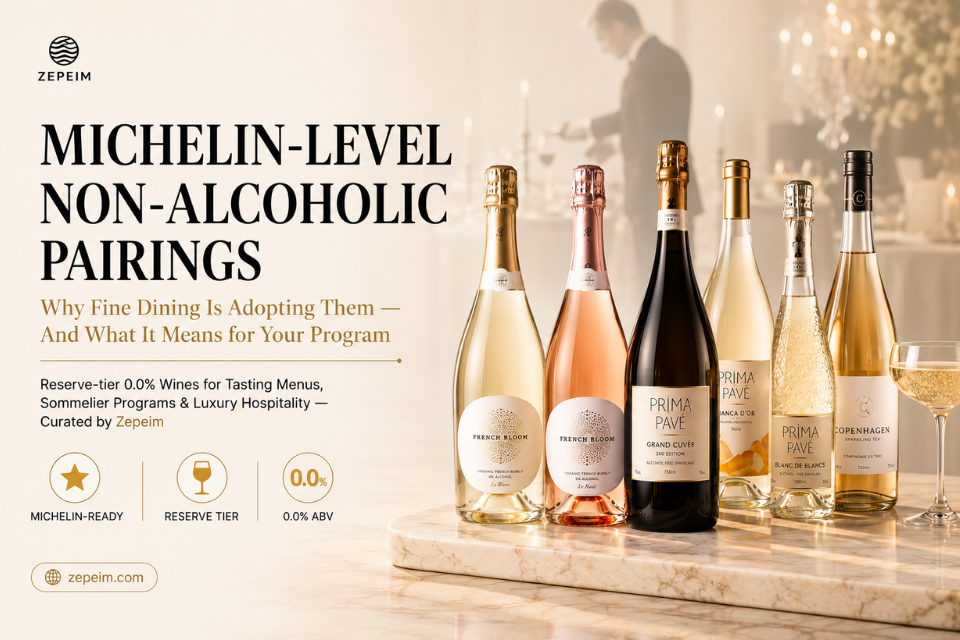
Why Michelin-Level Restaurants Are Adopting Non-Alcoholic Wine Pairings
The head sommelier at a Michelin-starred restaurant in California finished his pre-service tasting at 4:47 PM. He had walked through nine pours, evaluating each against the seven courses on that night's menu — but two of those pours were not wine. They were the non-alcoholic pairings now offered alongside the traditional flight, priced at $185 against the wine flight's $245. He marked his notes, set the bottles upright on the pass, and walked into staff briefing. Three years earlier, those NA pours would not have existed at his restaurant. Five years earlier, they would not have been credibly possible. Today, roughly one in four diners at his eighteen-seat counter chooses them. This is no longer an experiment at the edges of fine dining. It is a structural shift inside Michelin-level hospitality — and the producers, importers, and sommeliers who understood it early are now sitting at the front of a category that the rest of the industry is racing to catch.
Executive Summary
Across the Michelin Guide's listed restaurants in North America and Europe, non-alcoholic wine pairings have moved from rare to routine. Properties that historically offered nothing beyond water service to non-drinking guests now publish formal NA pairing flights — sometimes two or three tiers deep — priced at meaningful percentages of their alcoholic counterparts. The shift is real, it is measurable, and it is being driven by four forces simultaneously: a technical floor that has finally risen high enough for serious pairing, a sommelier discipline that now treats NA pairing as its own intellectual craft, a guest base that is broader and more affluent than the category historically assumed, and a revenue logic that fine-dining operators cannot afford to ignore.
For restaurants pursuing or holding Michelin recognition, hotel restaurants targeting that tier, and luxury hospitality groups building pairing-led concepts, the question is no longer whether to offer a non-alcoholic pairing program. It is which producers, which SKUs, and which distributors can deliver the consistency, supply reliability, and curatorial credibility that Reserve-level service demands. Through Zepeim's curated portfolio, the U.S. answer to that question has crystallized — and the brands featured in this article are the ones doing the work inside the country's most decorated kitchens.
The Michelin Shift Has Been Underway Longer Than the Industry Realized
The most-cited inflection point came in 2018, when Eleven Madison Park introduced a non-alcoholic pairing as a formal option on the tasting menu — an extension of the restaurant's evolving philosophy under Daniel Humm. The decision was treated at the time as a curiosity. In hindsight, it was a leading indicator. Within five years, restaurants with two and three Michelin stars from New York to Copenhagen to Tokyo were publishing their own NA flights, and sommeliers were being invited onto panels at industry conferences to discuss the discipline.
The pattern has been consistent across markets. Noma's beverage program in Copenhagen treats non-alcoholic pairings as a parallel intellectual exercise — not a substitute. Atomix in New York offers an NA flight that has become as discussed in food media as its wine pairings. The Eleven Madison Park program is now the subject of sommelier school case studies. And the Michelin Guide itself, while not formally evaluating non-alcoholic offerings as a star criterion, has begun mentioning them in restaurant write-ups when they reflect the chef's larger philosophy.
|
2018
Eleven Madison Park's NA Flight
|
~75%
Wine-Flight Price Parity
|
1 in 4
Diners Selecting NA Flight
|
What makes the shift durable — rather than a passing trend — is that it is driven by sommeliers themselves. Beverage directors at Michelin-level restaurants are not adopting non-alcoholic pairings because management asked them to. They are adopting them because the discipline has become genuinely interesting to people who think professionally about pairing. That is the kind of change that sticks.
How Sommelier Programs Are Actually Changing
A Michelin-level non-alcoholic pairing is not built the same way a casual restaurant's NA option is built. The intellectual scaffolding behind it is different, and the differences matter for any operator thinking about introducing one.
The first shift is conceptual. Where casual restaurants tend to ask "what NA beverage tastes most like wine?", Michelin-level sommeliers ask "what NA beverage is the most interesting partner for this dish?" That reframing opens the door to ingredients that an alcoholic pairing would never use — fermented teas, aged grape musts, low-temperature dealcoholized wines with intentionally amplified varietal character, savory shrubs, and clarified juices alongside genuine non-alcoholic wines. The pairing flight becomes its own composition, not a parallel translation.
The second shift is technical. Premium dealcoholization technology has reached a point where serious sparkling, structured whites, and tannic reds can be produced from real wine with their varietal character largely preserved. Brands like French Bloom (organic Chardonnay and Pinot Noir from southern France, backed by LVMH) and Prima Pavé (multi-medal-winning Northern Italian sparklings made from sustainably farmed grapes) now occupy positions on Michelin wine lists alongside grower Champagnes and Sancerre — not in a separate ghetto.
The third shift is operational. Michelin-level kitchens treat the NA pairing as a real revenue line, not a courtesy. The flight is staffed, trained, and tasted with the same rigor as the wine program. Service patter for it is rehearsed. Glassware is allocated. Bottle inventory is tracked. The discipline of treating NA service like wine service is what transforms a politely added option into a credible program.
Four Reasons the Adoption Is Accelerating in 2026
Adoption of non-alcoholic pairing programs in Michelin-level restaurants is not slowing. It is accelerating, and the reasons are not what most observers assume.
1. The economic argument has reversed. Until roughly 2022, the assumption was that an NA pairing took revenue away from the wine pairing. The actual data — from operators willing to share it — shows the opposite. The NA pairing captures revenue that previously walked away with the guest who didn't want to spend $245 on a wine flight they couldn't drink. A $185 NA flight where there was previously a $0 water service is pure incremental revenue. At twenty seats a night for 280 service nights, the math gets serious quickly.
2. The guest base is broader than expected. The diner ordering the NA flight at a Michelin restaurant is rarely abstinent for any single reason. They are pregnant guests at celebratory dinners. They are wellness-focused regulars. They are designated drivers from out of town. They are international travelers — particularly from Middle Eastern, South Asian, and increasingly East Asian markets — who expect a credible NA option at any property of this caliber. They are sober-curious affluent diners who want the wine experience without the wine. They are also, increasingly, half of a couple where the other half is drinking the wine pairing.
3. The supply chain has matured. The same brands now appear repeatedly across Michelin-level wine lists in different cities and countries. Prima Pavé. French Bloom. Copenhagen Sparkling Tea. Noughty. This is the signal of category maturation — when the same producers reliably ship to enough markets that beverage directors can build programs around them without supply anxiety. The U.S. importer infrastructure, with Zepeim as the most established player since 2016, has caught up to demand.
4. The cultural permission has shifted. Five years ago, ordering a non-alcoholic pairing at a serious restaurant carried subtle social cost. The guest was making a statement, or asking for a concession. Today, ordering the NA flight at a Michelin restaurant is treated by servers and sommeliers as a legitimate menu choice — sometimes the more interesting one. That permission is the most underappreciated driver of demand.
What this means for operators: A Michelin-level non-alcoholic pairing program in 2026 is no longer a forward-looking experiment. It is a competitive necessity for any property serious about pairing revenue, guest base expansion, and the operational signaling that increasingly factors into how the Michelin Guide and Michelin-watching critics describe a restaurant's philosophy.
Three SKUs Anchoring Michelin-Level Pairing Programs
The three selections below are doing real work in Reserve-level pairing flights across Zepeim's U.S. partner network. Each occupies a distinct position in a Michelin pairing arc — opening pour, premium sparkling course pour, and structured still white — and each meets the technical and curatorial bar that beverage directors at this tier require.
 |
0.0% · Organic · Halal · France
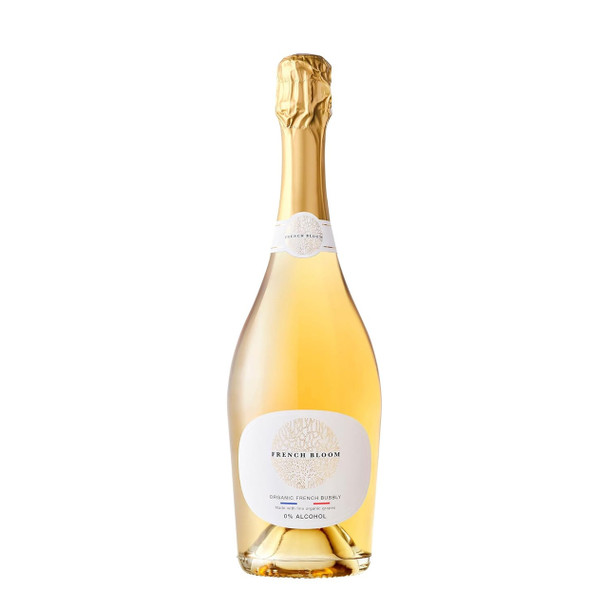
French Bloom Le BlancThe luxury benchmark of French non-alcoholic sparkling, founded by Maggie Frerejean-Taittinger and Constance Jablonski and backed by LVMH. Crafted from organic Chardonnay grapes in France through traditional fermentation followed by gentle dealcoholization. Pear, citrus, white flowers, elegant minerality, fine effervescence — built for the opening pour of a Michelin tasting menu where presentation and provenance both matter. Ideal for: Aperitif pours, amuse-bouche pairings, oysters and shellfish service, the toast moment that opens a tasting flight. View Product → |
 |
0.0% · Vegan · Reserve Tier · Italy
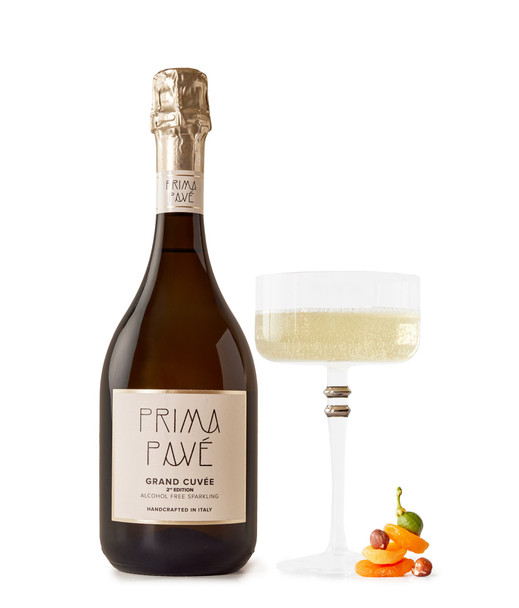
Prima Pavé Grand Cuvée 2nd EditionA multi-medal-winning Northern Italian sparkling expression blending Chardonnay and Pinot Grigio, made from sustainably farmed grapes with no added sugar. Aromas of orange blossom and orchard fruit lead to dried apricot, baked pear, and toasted hazelnut on the palate, with fine persistent bubbles and a structured dry finish. Built specifically for elevated pairing applications. Ideal for: Mid-course pairings with grilled lobster, crispy pork belly, Peking duck, creamy risotto, and truffle-based dishes where the wine needs to hold complexity. View Product → |
 |
0.0% · Vegan · Still White · Italy
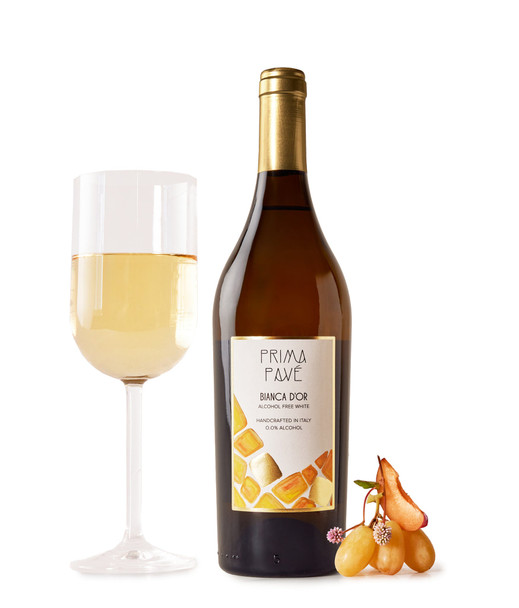
Prima Pavé Bianca D'OrA refined still white blending Gewürztraminer and Pinot Grigio from Northern Italy — produced from sustainably farmed grapes with the kind of aromatic lift that gives a sommelier pairing flexibility. Floral aromatics, stone fruit, hints of lychee, bright orchard fruit, silky texture, clean dry finish. Roughly 16.5 calories per 150ml. Built for pairing depth, not sweetness. Ideal for: Seafood risotto, pasta carbonara, aged blue cheese courses, vegetable-forward tasting menus, and the structured-still-white slot in a multi-course NA flight. View Product → |
Reserve-level pairing programs typically extend these three with French Bloom Le Rosé, Prima Pavé Fiamma red, and Copenhagen Sparkling Tea — already a documented presence in 3-Michelin star programs — to complete a five- or six-course NA flight. The full Zepeim Reserve portfolio is available for wholesale.
The Revenue Math Behind a Reserve NA Pairing Flight
A Michelin-level non-alcoholic pairing is priced at meaningful percentages of the wine flight — typically 65% to 80% — because the production cost of the underlying SKUs is real, the service rigor is identical, and the guest experience justifies the price. A $245 wine pairing might sit alongside a $185 NA flight, or a $300 wine pairing alongside a $220 NA option. The pricing logic mirrors the operational reality.
For Reserve programs willing to do the math: on a twenty-seat counter at 280 service nights, a 25% NA-flight attach rate at $185 represents roughly $259,000 in incremental annual revenue — revenue that, in most cases, simply did not exist in the program a few years earlier. Even at half that attach rate, the program clears six figures in incremental flight sales while expanding the addressable guest base.
Zepeim Wholesale Discount Structure
5% off — orders of 12+ cases (mix and match across the entire Reserve portfolio)
7.5% off — orders of 36+ cases
Free shipping — orders over $350 anywhere in the continental U.S.
Fast fulfillment — ships within 1 business day from Zepeim's Los Angeles warehouse, nationwide including Hawaii
Because Zepeim's volume discount applies across the curated portfolio rather than requiring inventory depth on any single SKU, a Reserve program can build a full multi-bottle NA flight at the 12-case or 36-case discount tier without overstocking. That matters when working with $44.99 and $45.00 bottle SKUs where carrying cost is real.
Who Actually Orders a $185 Non-Alcoholic Flight
Misreading this guest is the single most common mistake operators make when planning a Reserve NA program. The image of the abstinent customer is largely wrong. The actual buyer profile is wealthier, more selective, and more food-engaged than most beverage directors initially assume.
At a typical Michelin counter, the NA flight is ordered by guests who fall into a small number of clear archetypes. The traveling executive who has an early flight and wants the full pairing experience without the wine load. The wellness-focused regular who maintains a low-alcohol weeknight discipline but refuses to compromise on the chef's intent. The pregnant guest at a celebratory dinner who expects sommelier-level attention. The Halal-observant or sober traveler from an international market where premium non-alcoholic pairing is now a baseline expectation. The half-of-a-couple whose partner is drinking the wine flight and who wants the parallel ritual without the alcohol. The chef dining on a night off who wants to evaluate how the kitchen pairs without anesthetizing the palate.
None of these guests is poor. Most are paying full Michelin tasting menu prices and tipping accordingly. The category historically lost their wine-program spend because the answer to their question — "do you have a serious non-alcoholic pairing?" — was no. Today, at the venues that have built credible programs, the answer is yes, and the revenue follows.
How a Michelin-Level Program Actually Launches an NA Flight
A Reserve-level non-alcoholic pairing does not launch the same way a casual NA option launches. The phased approach below is the sequence most successful Michelin-aspirant programs have followed — typically over eight to twelve weeks before public launch.
| Phase | Timeline | Focus |
|---|---|---|
| 1. Sommelier Tasting | Weeks 1–2 | Order tasting cases of the Reserve-tier candidates: French Bloom Le Blanc, Prima Pavé Grand Cuvée, Bianca D'Or, plus Copenhagen Sparkling Tea and any complementary SKUs. Blind-taste against the alcoholic counterpart pairings. Identify which SKUs hold their structural integrity beside the kitchen's actual dishes. |
| 2. Pairing Build | Weeks 3–5 | Construct the actual flight — typically five to seven pours mirroring the tasting menu's course structure. Treat the flight as its own composition rather than a translation of the wine pairing. Document tasting notes, pairing rationale, and service patter for each pour. |
| 3. Staff Training | Weeks 6–7 | Train front of house on the flight with the same depth as the wine training. Cover producer stories, dealcoholization technique, and how to suggest-sell the NA flight as an intellectual choice rather than a courtesy option. Allocate dedicated stemware. |
| 4. Quiet Launch & Measure | Weeks 8–12 | Add the flight to the menu with no press push. Measure attach rate, guest feedback, and check-average impact over six to eight weeks. Refine pours and pricing before any public announcement. The strongest Michelin programs let the program prove itself before they talk about it. |
A Sommelier Discipline in Its Own Right
The most accurate read on what is happening inside Michelin-level beverage programs is also the simplest: non-alcoholic pairing has become a genuine sommelier discipline. It is being taught at wine programs. It is being debated at conferences. It is being written about by the food critics who follow the same restaurants whose alcoholic pairings they have spent decades analyzing. The category is no longer waiting for permission.
For Michelin-listed restaurants, Michelin-aspirant restaurants, and the hotel and luxury hospitality groups that build alongside them, the question for 2026 is not whether to add a non-alcoholic pairing — it is which producers, which curatorial partner, and what depth of program will signal that the venue is operating at the front of this shift rather than catching up to it. Zepeim — the U.S.'s most established non-alcoholic beverage importer since 2016 — is the curatorial partner the strongest programs in the country are already working with, and the Reserve portfolio detailed above is the toolkit they are building with.
Build Your Reserve-Level Non-Alcoholic Pairing Program
Apply for a Zepeim wholesale account to access the full curated Reserve portfolio — French Bloom, Prima Pavé, Copenhagen Sparkling Tea, and the broader luxury European catalog. Sommelier consultation available for Michelin-tier programs. Ships within one business day from Los Angeles. Nationwide delivery including Hawaii.
Apply for a Wholesale Account →Frequently Asked Questions
Recent Posts
-
Hidden Gems: Zero-Proof Champagne Alternatives
A senior wedding planner at a Manhattan events firm spent a January morning reviewing the previous …Aug 1st 2026 -
Exploring the World of Non-Alcoholic Aperitifs
The beverage manager of a boutique hotel in Boston's Back Bay walked her weekend team through the …Jul 29th 2026 -
Non-Alcoholic Cocktail Programs for Bars
The head bartender of a 40-seat cocktail bar in downtown Portland kept a paper notebook behind the …Jul 26th 2026