
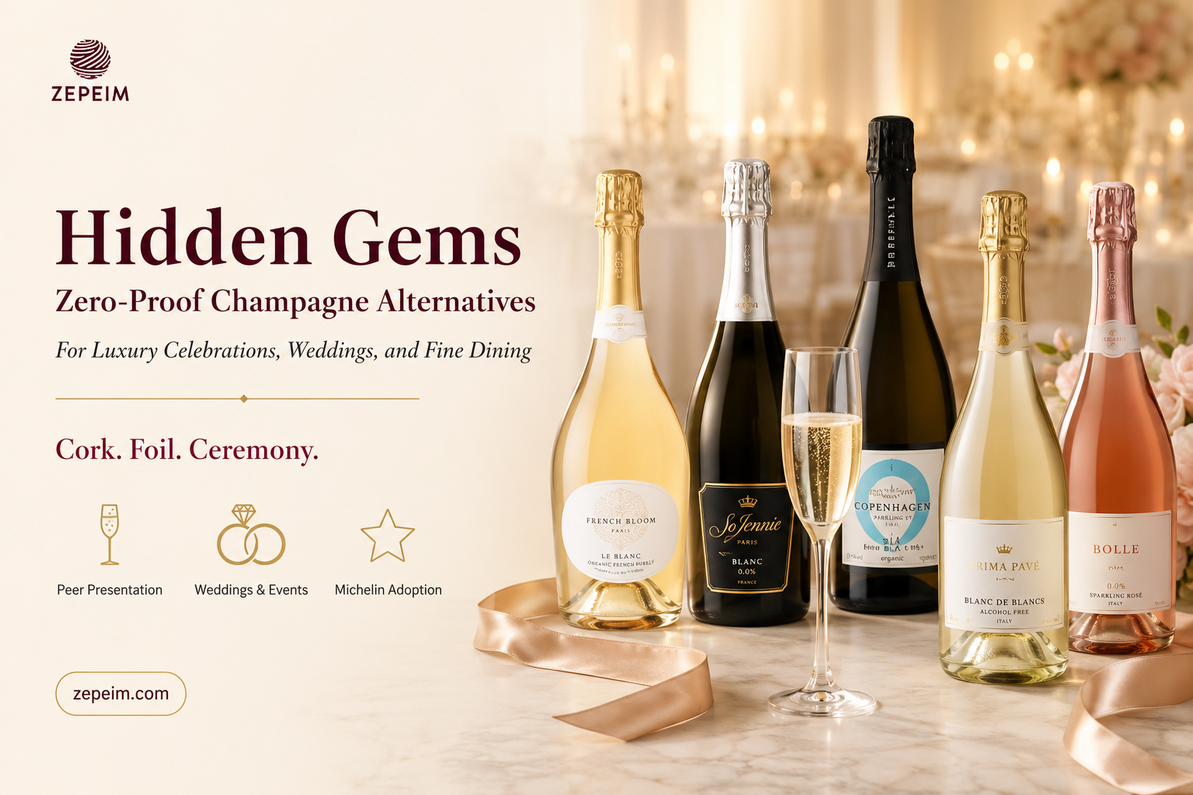
Hidden Gems: Zero-Proof Champagne Alternatives
A senior wedding planner at a Manhattan events firm spent a January morning reviewing the previous year's bar orders for the 32 weddings her firm had produced. One line on the spreadsheet had grown quietly and consistently across the year — non-alcoholic sparkling requests during ceremony toasts, welcome pours, and reception celebration moments. What had been a two-bottle courtesy add-on at the start of the year had become, by December, a formal line item on every venue order. The pregnant bride's toast. The bride's grandfather now three years sober. The Muslim guests at a Jewish-Muslim interfaith wedding. The recovering-alcohol executive who was giving the father-of-the-bride speech. The wellness-focused corporate wedding party who had asked specifically for "premium non-alcoholic sparkling that photographs like Champagne." Her old sparkling-cider-and-grape-juice fallback was no longer acceptable to these couples. What they wanted — and what they were willing to pay peer prices for — was a serious zero-proof Champagne alternative that arrived with cork, foil, and celebration-appropriate presentation. This guide walks through the specific bottles that have earned that reputation in the luxury hospitality category — the "hidden gems" of the zero-proof Champagne world — and how operators should think about integrating them into celebration, gifting, and fine-dining programs.
The Zero-Proof Champagne Alternative Has Come of Age
Non-alcoholic sparkling was, until quite recently, a compromised category. Guests choosing a zero-proof toast were making do with sparkling grape juice, sparkling cider, or an unmemorable dealcoholized sparkling wine that read as a poor substitute for Champagne. This is no longer the market operators are working with. Over the past three years, a small set of premium producers — from LVMH-backed French houses to Danish sparkling tea pioneers to award-winning Italian sparkling wineries — have brought the category into serious credibility. The best of these bottles now pour in three-Michelin restaurants, luxury hotels, first-class airline cabins, and celebration events where the visual and ritual standard is set by grand cuvée Champagne.
This guide covers the specific bottles that anchor a serious zero-proof Champagne alternative program in 2026 — the brands, the production styles, the service occasions where each performs strongest, and the pricing framework that captures the celebration-pour opportunity. For any hospitality operator building a wedding, celebration, corporate event, or luxury-dining program, these are the hidden gems worth knowing.
What Defines a Serious Zero-Proof Champagne Alternative
Not every non-alcoholic sparkling on the market qualifies as a genuine Champagne alternative. The specific characteristics that separate a serious celebration pour from a sparkling grape juice are consistent:
Real fine bubbles, not carbonation gas. Champagne's character depends on the size and behavior of the bubbles. Serious non-alcoholic sparkling either dealcoholizes traditionally fermented wine (preserving the natural bubble structure) or uses production techniques that create genuine fine bubbles — not gassy commodity carbonation.
Complex botanical or grape-derived flavor structure. A Champagne alternative must carry real flavor depth — either from the base wine (Chardonnay-based dealcoholized sparkling), organic teas and botanicals (Copenhagen Sparkling Tea's approach), or specialty verjus and fruit blends. The best bottles read as elegant and complex, not sweet and simple.
Presentation parity with Champagne. Real cork or premium closure. Foil top or wire cage. Glass bottle with shelf presence comparable to a genuine Champagne bottle. A Champagne alternative that arrives without visual formality signals that the offer is a step down; a bottle that arrives with the full ceremony reads as a peer product.
Production pedigree and quality signals. LVMH investment. Michelin restaurant placement. First-class airline service. International medal recognition. Sommelier endorsement. These are the credibility signals that separate a serious brand from a generic one — and they are increasingly what guests look for when the non-alcoholic option is expected to match the alcoholic version in ambition.
The Anchor Brands: Seven Zero-Proof Champagne Alternatives That Earn Their Place
The following seven producers anchor the serious Champagne alternative category in 2026. Each brings distinct production philosophy, tier positioning, and service application. The Zepeim Non-Alcoholic Sparkling Wine category centralizes the full range.
1. French Bloom (France)
The single most recognizable pedigree in luxury zero-proof sparkling. LVMH-backed, 0.0% ABV, made from organic French Chardonnay. Le Blanc (Blanc de Blancs) and Le Rosé are now standard fixtures on Michelin-level tasting menus and five-star hotel by-the-glass programs. The natural anchor for any Reserve-tier celebration pour. Available in matched 375ml half-bottle format for single-service occasions. See French Bloom on Zepeim.
2. So Jennie Paris (France)
Premium French sparkling rosé from Paris. Served in first- and business-class cabins on Qatar Airways, poured in five-star hotel lobby bars worldwide, and holder of a Diploma of Quality from the International Culinary Order. Design-forward packaging that reads as a curated gift and pours as a serious wine. A frequent choice at hospitality properties where guest experience is the central product. See So Jennie Paris on Zepeim.
3. Copenhagen Sparkling Tea (Denmark)
Born in Denmark and created by sommelier Jacob Kocemba, Copenhagen Sparkling Tea takes a fundamentally different approach — using up to 13 organic teas in each cuvée rather than dealcoholizing wine. The result is a 0.0% ABV sparkling that delivers wine-like complexity and pours in over 100 Michelin-starred restaurants globally. Because it is never fermented, it is a particularly clean choice for guests who avoid alcohol entirely (pregnant, observant, or in recovery). The BLÅ (blue), LYSERØD (rosé), and LYSEGRØN (green) cuvées span the range. See Copenhagen Sparkling Tea on Zepeim.
4. Kolonne Null Cuvée Blanc Sparkling (Germany)
Germany's reference for dealcoholized wine. Made in partnership with top European wineries, Kolonne Null's Cuvée Blanc Sparkling delivers a true Champagne-style experience at <0.5% ABV. The precision approach — clean, dry, structured — anchors serious wine-list placements at restaurants that want a dealcoholized sparkling with wine-lineage credibility. See Kolonne Null on Zepeim.
5. Prima Pavé (Italy)
Award-winning Italian sparkling with multi-medal international recognition. Blanc de Blancs and Rosé Brut anchor the range, with 200ml single-serve formats also available for aperitivo, event, and single-service pours. A strong choice where Italian craft credibility carries weight — celebration events, high-end catering, and specialty retail merchandising. See Prima Pavé on Zepeim.
6. BOLLE (USA)
American-produced luxury sparkling with critic-scored recognition — the 93-point Sparkling Rosé and 91-point Blanc de Blancs. Designed specifically for by-the-glass programs and single-service occasions with full cork-and-cage presentation. 375ml half-bottle format available for tasting flights and single-service celebration moments. See BOLLE on Zepeim.
7. Princess Alternativa Bollicine (Italy)
Italian 0.0% sparkling — and importantly, Halal-certified. The natural anchor when the celebration includes observant Muslim guests, interfaith weddings, or corporate events where inclusive celebration pours are a requirement. Bollicine Bianco Extra Dry Sparkling White delivers the presentation and ritual of Champagne while remaining fully appropriate for every guest. See Princess Alternativa on Zepeim.
Where Zero-Proof Champagne Alternatives Deliver the Most Value
Weddings and Life-Event Celebrations
The single largest use case. Every wedding now includes at least one guest — pregnant, in recovery, observant, or personal choice — who cannot participate in the alcoholic Champagne toast. Historically these guests raised a glass of sparkling water. In 2026, the expectation is a genuine zero-proof Champagne alternative that pours alongside the alcoholic bottle without visual downgrade. See our Catering & Events program guide for wedding-specific integration.
Holiday and Seasonal Celebration Programs
Fourth of July, New Year's Eve, milestone birthdays, and holiday-season celebration menus all benefit from a serious zero-proof sparkling on the by-the-glass and bottle list. Pricing at peer level to the alcoholic sparkling captures the guest segment that previously ordered sparkling water — meaningful margin over a busy holiday week.
Corporate Gifting Programs
Zero-proof Champagne alternatives have become the natural anchor for premium corporate gifting programs — client appreciation, executive holiday gifts, milestone recognition. The bottles present as celebration gifts and remain universally appropriate across recipient lifestyles. See our full framework in Corporate Gifting with Purpose.
Fine Dining and Michelin-Level Restaurant Programs
Reserve-tier sparkling on the by-the-glass list, dedicated non-alcoholic pairing flights, and celebration bottle service at three-Michelin-star and equivalent restaurants. See our Luxury Non-Alcoholic Beverage Report for the fuller framework at this tier.
Luxury Hotel Programs
Minibar programs, welcome-amenity service, lobby lounge menus, and property-wide beverage lists at five-star hotels increasingly anchor Reserve-tier zero-proof sparkling. The 375ml half-bottle format is especially valuable here — see our Half Bottles, Full Potential guide for detail on the format's role in minibar and single-service programs.
Pricing Zero-Proof Champagne Alternatives at Peer Level
The pricing principle for premium non-alcoholic sparkling is the same principle that applies across the Reserve-tier non-alcoholic category: peer pricing to the alcoholic version. A Reserve-tier zero-proof sparkling by-the-glass pour at a luxury venue should be priced at 85–100 percent of the equivalent alcoholic sparkling wine pour. Bottle pricing should be structured at the same margin percentage as the alcoholic list — not discounted.
This is the pricing point the market has already validated at the top of the hospitality segment. Guests choosing a zero-proof Champagne alternative for their celebration are not looking for a discount option — they are looking for a serious pour worthy of the moment, and they pay accordingly. Discounted pricing signals that the offer is a second-tier product; peer pricing signals that the offer is a peer product. For the fuller margin framework, see our Maximizing Margins with Non-Alcoholic Beverages guide.
Implementation: Building a Serious Zero-Proof Champagne Program
| Phase | Timing | Key Actions |
|---|---|---|
| Phase 1 — Sample & Taste | Weeks 1–2 | Request Zepeim sample kit across the seven anchor brands. Sommelier taste-through with beverage director. Compare against current alcoholic Champagne benchmarks. |
| Phase 2 — Curate | Weeks 3–4 | Select 2–4 anchor brands across white, rosé, and specialty tea styles. Add 375ml half-bottle formats for single-service occasions. |
| Phase 3 — Menu & Placement | Weeks 5–6 | Place bottles on by-the-glass and bottle lists, integrate into event menus, wedding packages, and gifting bundles. Set peer pricing. |
| Phase 4 — Team Training | Weeks 7–8 | Train sommeliers, event planners, and service teams on brand stories, pairing logic, and full celebration pour ceremony (cork, cage, glass, garnish where appropriate). |
| Phase 5 — Launch & Track | Week 9+ | Program goes live. Track celebration pour attach rate, event menu adoption, and guest feedback. Expand into new anchor brands as demand indicates. |
Conclusion: Celebration Without Compromise
A celebration pour that reads as an apology — sparkling water, sparkling grape juice, or a downgraded second-tier bottle — sends the wrong signal to the guest who is choosing not to drink alcohol at that moment. A celebration pour that reads as a genuine peer to the Champagne being poured around them signals that the venue has treated the non-alcoholic guest with the same consideration as everyone else at the table.
The seven anchor brands in this guide — French Bloom, So Jennie Paris, Copenhagen Sparkling Tea, Kolonne Null, Prima Pavé, BOLLE, and Princess Alternativa — represent the specific bottles that have earned that credibility across the luxury hospitality category. Building a serious zero-proof Champagne alternative program with a specialist distributor whose portfolio spans all seven is what the strongest wedding, event, hotel, and fine-dining programs are already doing. The rest of the market will follow — the operators moving now are the ones building the reputation that comes with leading rather than reacting.
Explore the Program Guide That Fits Your Venue
Celebration pours deliver value across every luxury hospitality channel. Zepeim's Beverage Program guides cover the specifics:
| Catering & Events → | Hotels & Resorts → | Restaurants → | All Programs → |
Ready to Build a Serious Zero-Proof Champagne Program?
Apply for a Zepeim wholesale account to access French Bloom, So Jennie Paris, Copenhagen Sparkling Tea, Kolonne Null, Prima Pavé, BOLLE, Princess Alternativa, and the full curated non-alcoholic sparkling portfolio. Sommelier consultation, sample kits, and case-tier volume discounts apply from the first order forward — with fulfillment from the Los Angeles warehouse to all 50 states.
Apply for a Wholesale Account →Frequently Asked Questions
Recent Posts
-
Hidden Gems: Zero-Proof Champagne Alternatives
A senior wedding planner at a Manhattan events firm spent a January morning reviewing the previous …Aug 1st 2026 -
Exploring the World of Non-Alcoholic Aperitifs
The beverage manager of a boutique hotel in Boston's Back Bay walked her weekend team through the …Jul 29th 2026 -
Non-Alcoholic Cocktail Programs for Bars
The head bartender of a 40-seat cocktail bar in downtown Portland kept a paper notebook behind the …Jul 26th 2026