
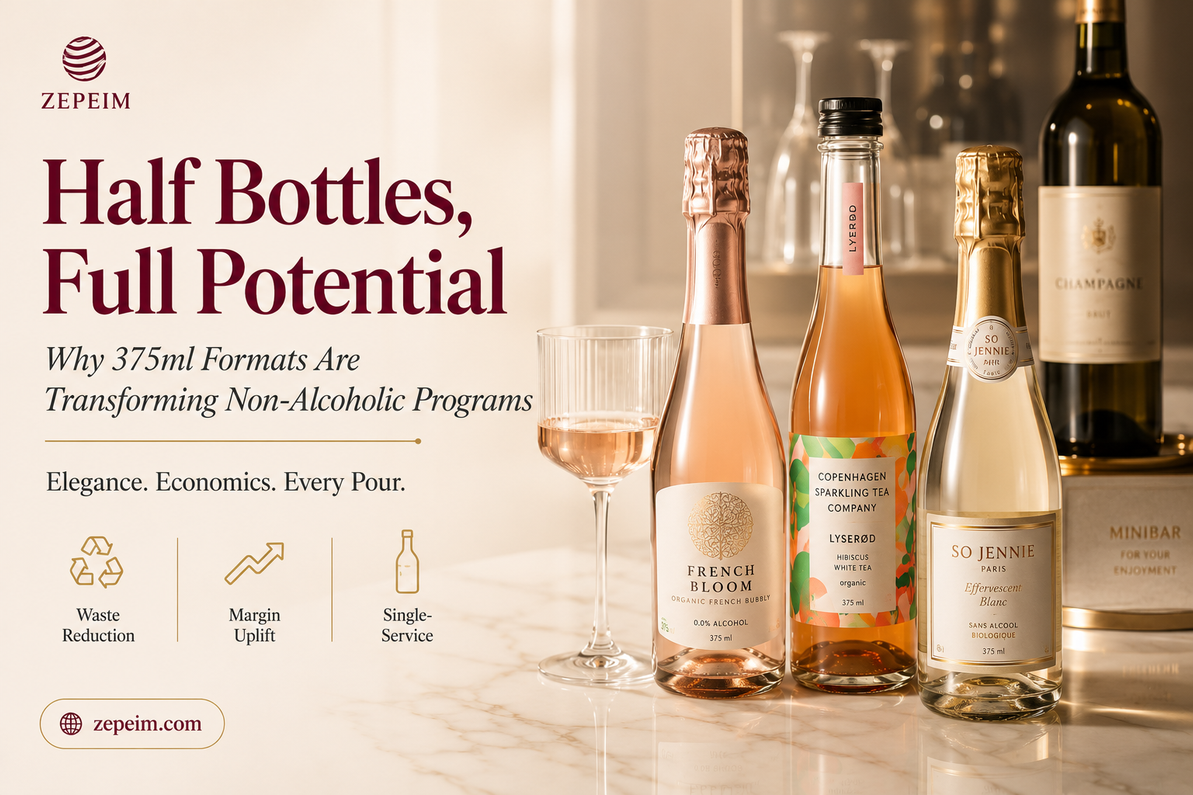
Half Bottles, Full Potential: Why 375ml Formats Are Good for Business
The Director of Food and Beverage at a 220-room luxury property in Miami spent a Tuesday morning in January pulling twelve months of minibar-inventory data across her floors. The pattern was consistent and expensive: 750ml sparkling and wine bottles that had been opened for guest turndown service — some for a single pour to accompany welcome amenities — were being discarded within 48 hours as room turnover continued. The waste ratio on her non-alcoholic sparkling program specifically was hovering around 40 percent. Then she looked at the numbers on the same brands sold in 375ml half-bottle format: no open-bottle waste, single-service pricing that captured a stronger per-milliliter margin, and a presentation that guests actually preferred because the bottle looked considered rather than leftover. Within a quarter, she had shifted the entire minibar and welcome-amenity program to the smaller format. Her waste ratio fell to under 5 percent. Her per-room beverage margin improved by an amount she was, frankly, embarrassed she had not caught sooner. Her experience is not unusual — it reflects a broader operator awakening in 2026 to the specific economics of 375ml formats in the non-alcoholic category. This is the guide to those economics, and the operators for whom the half-bottle format matters most.
Why 375ml Non-Alcoholic Formats Deserve Serious Attention in 2026
The 375ml half-bottle format has been a specialty option in wine and Champagne for decades — usually associated with sommelier-driven tasting flights, business-class airline service, or the occasional single-diner order at a fine restaurant. In the alcohol-free category, however, the same format has quietly become something more consequential. Premium non-alcoholic producers now increasingly release their flagship cuvées in matched 375ml half-bottles specifically because operators — hoteliers, restaurateurs, event caterers, and retailers — are demonstrating that the format solves problems the 750ml simply cannot.
This article walks through the specific business logic. The 375ml format is not a novelty. It is an operational tool with measurable financial impact — one that reduces waste, improves per-milliliter margin, expands service occasions, and unlocks single-service placements where a full bottle simply does not fit the operation. For operators building or refreshing a serious non-alcoholic program in 2026, the half-bottle format deserves a dedicated line on the buying decision, not a secondary afterthought.
The Four Economic Advantages of 375ml Half-Bottles
1. Waste Reduction on Sparkling Programs
The single largest operational cost in a sparkling by-the-glass or minibar program is open-bottle waste. A 750ml sparkling bottle that has been opened yields two-and-a-half serving pours; after that, carbonation degradation and quality loss compound quickly. In hotel minibar and welcome-amenity programs where turnover is irregular, waste ratios on 750ml sparkling frequently exceed 30–40 percent. A 375ml half-bottle used for the same service occasion is fresh, uncompromised, and single-service — waste falls close to zero. The math on this alone often justifies the format switch for sparkling-focused operators.
2. Improved Per-Milliliter Margin
Half-bottle formats carry what wine-industry professionals call a "prestige premium" — a higher price per liter than the 750ml equivalent, absorbed comfortably by the consumer because the single-service, curated presentation is perceived as worth more. A 375ml half-bottle of premium sparkling at a hotel minibar can be priced at 60–70 percent of the 750ml retail rate for 50 percent of the volume, yielding a materially stronger per-milliliter margin. Guests do not object because the value equation — a full, elegant bottle presented as a single service — reads as premium rather than portion-controlled.
|
30–40%
Typical 750ml Sparkling Waste in Minibar Programs
|
<5%
Waste on 375ml Single-Service Alternative
|
2 Pours
Per 375ml Half-Bottle
|
3. Access to New Service Occasions
The 375ml format unlocks service moments the 750ml cannot serve. Tasting flights in restaurants and hotels. Non-alcoholic pairings that require pouring three or four different products in sequence without commitment to a full bottle each. In-flight service across airlines and business-class programs. Retail 4-pack merchandising for grocery and specialty channels. Single-diner service in fine-dining rooms. Corporate gifting bundles that need multiple format sizes for a curated selection. Each of these represents a real revenue opportunity that a 750ml-only program simply cannot address.
4. Presentation and Perception Value
A 375ml half-bottle presented with cork, foil, and label intact reads as luxurious. A partially-poured 750ml on ice reads as leftover. In hospitality contexts where guest experience is a central product — luxury hotels, fine dining, premium events — the difference between these two presentations is measurable in guest satisfaction scores. The half-bottle format is what industry insiders call a "quiet upgrade" — it doesn't cost the operator meaningfully more per pour, but it consistently elevates how the experience is perceived.
Where 375ml Half-Bottles Deliver the Highest Operational Value
Hotel Minibar and In-Room Programs
The single largest use case. Minibar programs face the classic tradeoff between premium presentation and open-bottle waste. The 375ml format eliminates the tradeoff. A guest opens a fresh, cork-topped, foil-wrapped half-bottle at their leisure without the operator ever discarding a partial bottle. For pregnancy-friendly minibar options, guest wellness programs, and the growing sober-curious luxury guest segment, this format is now standard. See our Hotels & Resorts program guide for a fuller framework on hotel non-alcoholic programs.
Restaurant By-the-Glass and Tasting Flight Programs
Restaurants running non-alcoholic pairing programs — whether Michelin-level tasting menus or approachable fine dining — increasingly use the 375ml format to enable side-by-side flights without over-committing case volume to slower-moving pours. Solo diners who want a serious non-alcoholic pour without a full-bottle commitment appreciate the format. For an in-depth look at pairing programs at the top end, see our analysis of Michelin-level non-alcoholic pairing programs.
Retail and Bottle Shop Merchandising
Specialty retail and bottle shops are increasingly merchandising 375ml formats as 4-pack or mixed-case gifting units — a price point that invites trial without the commitment of a full 750ml bottle. For a category that still benefits from consumer discovery, the 375ml gives shoppers the "try before you buy the big bottle" entry point. See our Retail & Bottle Shops program guide for merchandising strategy detail.
Corporate Gifting and Curated Bundles
Half-bottles are the natural building block for curated gifting bundles — allowing three or four different bottles in a mixed-case gift where a 750ml-only approach would be unwieldy. This is especially valuable for corporate gifting programs, event welcome bags, and hospitality-partnered promotional programs. Our full framework for structured non-alcoholic gifting is covered in Corporate Gifting with Purpose.
Catering, Events, and Wedding Programs
For weddings and corporate events with mixed drinking and non-drinking guest lists, the 375ml format enables a genuinely elegant non-alcoholic option that presents alongside Champagne rather than beneath it. Half-bottles at each place setting where non-alcoholic guests are seated — with the same visual formality as the wine service — is now a common approach in luxury event planning.
Airlines, Trains, and Business-Class Service
Premium travel channels have always used 375ml (and smaller) formats for practical service reasons. In the non-alcoholic space, airlines and rail services are increasingly matching their premium wine and Champagne service with matched half-bottle non-alcoholic pairings — allowing pregnant guests, sober guests, and travelers observing cultural restrictions to receive the same presentation standard as everyone else.
Premium Non-Alcoholic Brands Available in 375ml Format
The 375ml format is available across the strongest anchors of a serious non-alcoholic program. Zepeim's Single-Serving & Small Bottles category centralizes half-bottles (375ml), splits and singles (200ml), and other smaller formats for buyers building single-service programs.
French Bloom. The LVMH-backed French sparkling brand releases its flagship Le Blanc and Le Rosé in matched 375ml half-bottles — the same organic Chardonnay cuvées, sized for luxury single-service. The natural anchor for luxury hotel minibar and premium event programs.
Copenhagen Sparkling Tea. The complete range — BLÅ, LYSERØD, and LYSEGRØN — available in 375ml half-bottle format. Poured in over 100 Michelin-starred restaurants, the format is a natural fit for tasting flights and by-the-glass pairing programs.
So Jennie Paris. The Blanc format in 375ml — designed for premium single-service pours and available for luxury hotel and airline programs.
BOLLE. The 93-point Sparkling Rosé and 91-point Blanc de Blancs in 375ml half-bottle format — built specifically for by-the-glass programs, single-service, and tasting flights with the full cork-and-cage presentation.
Kolonne Null. Sparkling Rosé in 375ml format — a dealcoholized German non-alcoholic wine option for the mid-tier of a program.
For smaller service formats — 200ml single-serve splits — Prima Pavé offers its Blanc de Blancs and Rosé Brut in 200ml Case-24 configurations. These are the smallest formats in the Zepeim range, purpose-built for the aperitivo, event, and single-service occasions where even a 375ml is too much.
Financial Framework: When Half-Bottles Justify the Switch
The financial case for the 375ml format is strongest when three conditions apply:
1. Waste is a measurable cost. If your program discards more than 15 percent of opened sparkling bottles due to turnover mismatch, the 375ml format pays for itself in waste reduction alone. Hotels, minibars, and event caterers face this cost most consistently.
2. Service occasions are single-serve by nature. Welcome-amenity service, tasting flights, business-class in-flight, single-diner fine dining, and celebration room-service moments are all inherently single-service. A 750ml bottle is over-provisioned for these occasions by design.
3. Presentation quality drives revenue. Where premium presentation directly affects pricing power — luxury hotels, fine dining, event venues, retail gifting bundles — the elevated perception value of a fresh, cork-topped half-bottle over a partial 750ml pour translates into stronger per-service revenue.
For a broader look at how non-alcoholic beverage programs contribute to hospitality margins, see our Maximizing Margins with Non-Alcoholic Beverages guide.
Implementation Strategy: Adding 375ml Formats to Your Program
| Phase | Timing | Key Actions |
|---|---|---|
| Phase 1 — Audit | Weeks 1–2 | Measure current 750ml waste ratio, identify single-service occasions, calculate potential margin impact of format switch. |
| Phase 2 — Selection | Weeks 3–4 | Match brands to service occasions, place initial order for 1–2 half-bottle SKUs to pilot alongside existing 750ml program. |
| Phase 3 — Pilot | Weeks 5–10 | Run parallel with 750ml program for six weeks, measure waste ratio, guest satisfaction, and margin performance side-by-side. |
| Phase 4 — Scale | Weeks 11+ | Expand successful pilot to additional formats and brands, adjust 750ml order volumes accordingly, refine service protocols. |
| Phase 5 — Optimize | Ongoing | Track quarterly waste and margin metrics, expand to additional service occasions, evaluate 200ml single-serve as complement. |
Conclusion: A Format Decision Worth Making
The 375ml half-bottle is not a novelty format, and it is not a step down from the 750ml. It is a specific operational tool that solves specific problems — waste, presentation, per-service margin, and access to service occasions the 750ml simply cannot address. For hotels running minibar and welcome-amenity programs, for restaurants building serious pairing flights, for retailers merchandising for gifting and discovery, and for caterers serving mixed guest lists at events, the format is now foundational.
The strongest non-alcoholic programs in 2026 are running matched 750ml and 375ml SKUs of their flagship brands — the 750ml for bottle service and back-bar depth, the 375ml for single-service, tasting flights, and premium presentation moments. For operators still running 750ml-only, the pilot cost is low, the measurement window is short, and the operational upside is often meaningful. This is the format decision worth making in the year ahead.
Explore the Program Guide That Fits Your Operation
Half-bottle formats deliver different operational value in different venues. Zepeim's Beverage Program guides cover the specifics for each channel:
| Hotels & Resorts → | Restaurants → | Retail & Bottle Shops → | Catering & Events → |
Ready to Add 375ml Formats to Your Program?
Apply for a Zepeim wholesale account to access the full range of premium non-alcoholic 375ml half-bottles from French Bloom, Copenhagen Sparkling Tea, So Jennie Paris, BOLLE, Kolonne Null, and more — plus 200ml single-serve formats from Prima Pavé. Mix-and-match volume discounts apply across every SKU and format in the portfolio.
Apply for a Wholesale Account →Frequently Asked Questions
Recent Posts
-
Hidden Gems: Zero-Proof Champagne Alternatives
A senior wedding planner at a Manhattan events firm spent a January morning reviewing the previous …Aug 1st 2026 -
Exploring the World of Non-Alcoholic Aperitifs
The beverage manager of a boutique hotel in Boston's Back Bay walked her weekend team through the …Jul 29th 2026 -
Non-Alcoholic Cocktail Programs for Bars
The head bartender of a 40-seat cocktail bar in downtown Portland kept a paper notebook behind the …Jul 26th 2026