
Non-Alcoholic Cocktail Programs for Bars
The head bartender of a 40-seat cocktail bar in downtown Portland kept a paper notebook behind the well for tracking the non-alcoholic orders his team was building on the fly during service. By the end of an average Friday night he was logging 15 to 20 entries — guests asking for "something serious without alcohol," a bourbon-drinker's designated driver, a wine-drinker taking a break for the evening, a pregnant guest who wanted more than a cranberry-and-soda, a whiskey-drinker on Dry January feeling out the market. His response for each was the same familiar improvisation — a shrub, a citrus-forward mocktail, whatever the mise en place could support in the middle of a rush. His bar had built its reputation on a serious cocktail program, and he could feel the disconnect: a bar known for craft was serving craft only when the guest ordered alcohol. His decision that quarter was to build a genuine non-alcoholic cocktail program with the same rigor as his back bar — spec sheets, dedicated non-alcoholic spirits and aperitifs, a printed menu section, batching where it made sense, and bartender training on the whole range. Within two months, non-alcoholic orders were rising in count and in average ticket, and his bar had become one of the destinations his sober-curious guests were recommending to each other. This guide is written for the operators in his position. It walks through how to build a serious non-alcoholic cocktail program at your bar in 2026 — the specific spirit categories to stock, the classic cocktail templates that translate cleanly, the bartender training that turns a stocked bottle into a sold pour, and the pricing framework that captures full margin.
Why Bars Need a Serious Non-Alcoholic Cocktail Program in 2026
The non-alcoholic cocktail category has crossed the same threshold that non-alcoholic wine did three years ago. What was previously a courtesy improvisation — a mocktail invented on the fly, a shrub thrown together during service, a "let me see what I can do for you" moment at the bar — has become an expected core competency for any serious cocktail program. Guests are ordering non-alcoholic cocktails intentionally rather than apologetically. They are paying peer prices to their alcoholic counterparts. And they are choosing bars specifically for whether or not the non-alcoholic list is credible.
This guide walks through the specific frameworks that make a non-alcoholic cocktail program work: portfolio coverage across the six spirit and aperitif categories that every serious bar should stock, menu design principles that separate a real program from a courtesy mocktail section, bartender training that turns technique into confident recommendations, and pricing structure that captures full margin. For any bar building or refreshing its non-alcoholic program in 2026, this is the operational playbook.
The 2026 Bar Market Reality
The specific dynamics driving non-alcoholic cocktail demand at the bar level in 2026 are different from what pushed non-alcoholic wine forward earlier in the decade. Understanding them shapes how the program is built.
|
+47%
Restaurant & Bar NA Menu Additions YoY (SpotOn 2026)
|
32.7%
Zero/Low-Proof Share of NA Menu Growth
|
$925M
NA Off-Premise Sales, +22% YoY (NIQ)
|
Sober-curious drinkers have specific bar preferences. This is a segment that engages with craft cocktail culture, follows bartenders and menus, and expects a bar to have a serious non-alcoholic section — not a two-item courtesy afterthought. They compare bars on non-alcoholic depth and share recommendations within their networks.
Mindful drinkers are moderating within visits, not skipping visits. A guest who used to have four cocktails now has two cocktails and two non-alcoholic pours. The bar loses the ticket entirely if the non-alcoholic offer is weak; it captures the full ticket at peer margin if the non-alcoholic offer is serious.
Designated drivers and pregnant guests want peer experience. Where these guests were previously willing to accept a sparkling water for the evening, the 2026 expectation is a cocktail-quality alternative that presents alongside the alcoholic drinks at the table. A weak offer signals that the bar has not caught up.
Corporate and business drinkers are increasingly public about moderation. Executives entertaining clients, professionals in client-facing industries, and athletes in visible fields all increasingly order non-alcoholic pours at a bar in front of their colleagues without apology. The bar that has a credible list captures this segment; the bar that doesn't loses it.
The Six Non-Alcoholic Spirit Categories Every Bar Should Stock
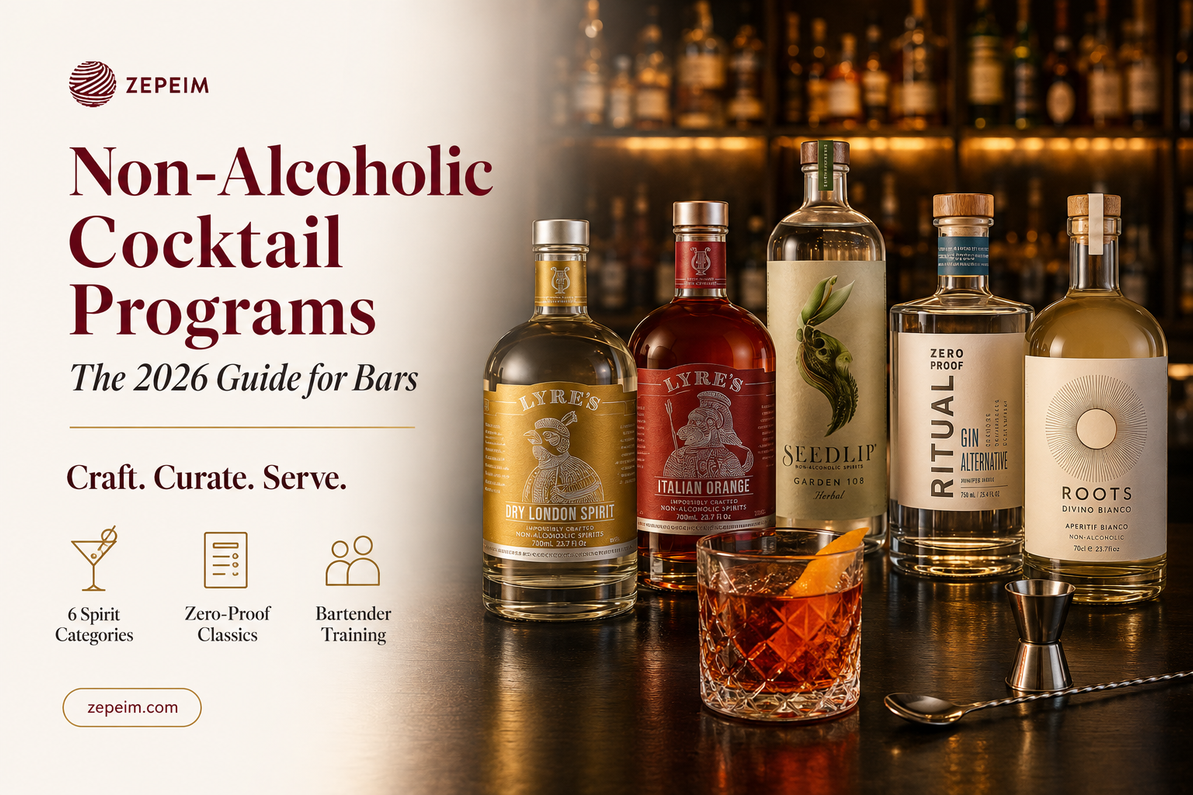
A serious non-alcoholic bar program is built around the same category framework as an alcoholic back bar. Each of the six categories below anchors specific cocktail styles and gives the bartender the tools to build a credible zero-proof version of the classics guests already order. The Non-Alcoholic Spirits, Mixers & Aperitifs category centralizes the full range.
1. Non-Alcoholic Gin
The single most versatile category and the one most bars should stock first. Non-alcoholic gin covers everything from Gin & Tonic to Negroni to Martini variants, and the category has matured significantly — the best options carry real botanical structure, juniper presence, and mixing versatility. Brand anchors: Lyre's, Seedlip, and Ritual Zero Proof. See the non-alcoholic gin category for the full range.
2. Non-Alcoholic Whiskey / Bourbon Alternative
The category that unlocks the Old Fashioned, Whiskey Sour, and Manhattan-style templates. Non-alcoholic whiskey alternatives have made real gains in flavor depth over the past two years — the best of them carry caramel, toasted-oak, and smoke notes that stand up in stirred and shaken cocktails. Anchor brands: Lyre's American Malt and Ritual Zero Proof Whiskey.
3. Non-Alcoholic Aperitif (Bitter Orange & Vermouth)
The most cocktail-critical category — non-alcoholic Aperol-style and vermouth-style products enable the Spritz, the Negroni, and virtually every stirred cocktail with a bitter or fortified-wine component. This is where craft bars differentiate their non-alcoholic offer from casual bars. Anchor brands: Lyre's Italian Orange (Aperol-style), Lyre's Aperitif Rosso (vermouth-style), Roots Divino, and Melati. See the non-alcoholic aperitif and digestif category for the full range.
4. Non-Alcoholic Rum / Dark Spirits
The Daiquiri, the Mojito, the Piña Colada, and the Dark & Stormy all require a rum-style base. Non-alcoholic rum alternatives — Lyre's Dark Cane and Ritual Zero Proof Rum — are the workhorses for tropical, tiki, and cane-forward cocktail templates.
5. Non-Alcoholic Agave / Tequila Alternative
The Margarita, the Paloma, and agave-forward modern cocktails require an agave-style base. Seedlip Notas de Agave and Ritual Zero Proof Tequila are the anchor selections. This category has grown quickly in 2026 as consumer preference for agave spirits has continued to lift the non-alcoholic equivalent.
6. Specialty & Liqueur Alternatives
Coffee liqueur (Espresso Martini template), amaretto (Amaretto Sour), and absinthe alternatives round out the specialty category and enable a wider range of classic cocktail templates. Lyre's Coffee Originale and Lyre's Absinthe are the anchor selections here.
For deeper context on how aperitifs specifically are driving cocktail innovation, see our companion guide Non-Alcoholic Apéritifs Are Driving Cocktail Innovation.
Designing the Non-Alcoholic Cocktail Menu
A serious non-alcoholic cocktail program lives on a dedicated menu section — not a footnote at the bottom of the drink list, and not a "please ask your bartender" one-liner. The specific menu structure that works best in 2026 blends two distinct approaches:
Zero-proof classics. Direct non-alcoholic translations of the cocktails guests already know and order — the Non-Alcoholic Negroni, the Zero-Proof Old Fashioned, the No-Proof Aperol Spritz, the Non-Alcoholic Margarita, the Zero-Proof Espresso Martini. These are the entry points for guests unfamiliar with the category. A guest who has just switched to non-alcoholic for the evening knows what a Negroni is; giving them a non-alcoholic Negroni removes the friction of choosing something unfamiliar.
Original zero-proof cocktails. The second half of the menu — original creations built with non-alcoholic spirits, aperitifs, shrubs, syrups, and garnishes designed specifically for the format. These are what the sober-curious cocktail enthusiast looks for on your menu. Original cocktails demonstrate that the bar has treated the non-alcoholic offer with the same creative energy as the alcoholic list.
Batching for volume service. Where cocktail complexity would compromise service speed, batching is critical. Shelf-stable aperitifs like Melati Classic and Roots Divino Bianco can be pre-diluted, chilled, and drawn on tap or from batch bottles during high-volume moments. This is how serious cocktail bars maintain execution speed on non-alcoholic during busy service without dragging on ticket times.
Bartender Training: The Difference Between Stocking and Selling
The most common failure mode in a non-alcoholic bar program is the same one that plagues restaurant non-alcoholic wine lists: the bar orders the bottles, prints the menu, and then loses the revenue because bartenders default to the same tired "we have some non-alcoholic options" script when a guest declines alcohol.
A non-alcoholic training program at the bar level covers four specific areas. First, brand and product knowledge — bartenders need to speak fluently about the flavor profile of each non-alcoholic spirit, aperitif, and mixer on the back bar, and understand how they behave in cocktail construction. Second, technique adaptation — non-alcoholic cocktails require different balance choices around dilution, garnish, and glassware because they lack the alcohol structure that carries flavor differently in the mouth. Third, confident suggestion scripting — bartenders trained to proactively offer a non-alcoholic Negroni to a guest asking for "something interesting without alcohol" convert dramatically more of those moments into sold pours than bartenders waiting to be asked. Fourth, service consistency — the non-alcoholic cocktail should arrive with the same glassware, garnish, and presentation ceremony as the alcoholic version. The guest experience must not signal that non-alcoholic is a discount category.
For the broader framework on staff training as a sales lever, see our guide Train Your Staff to Sell Non-Alcoholic Drinks With Confidence.
Pricing Framework for Non-Alcoholic Cocktails
The pricing principle for non-alcoholic cocktails is the simplest of any part of the program: price them identically to their alcoholic counterparts. A non-alcoholic Negroni should cost the same as an alcoholic Negroni. A zero-proof Old Fashioned should cost the same as an alcoholic Old Fashioned. This is the pricing framework the market has already validated at serious cocktail bars — guests expect and accept peer pricing because the labor cost, ingredient complexity, and presentation are identical to the alcoholic version.
Discounting the non-alcoholic cocktail by 20–30 percent — a common early-program mistake — signals to the guest that the offering is a second-tier product and leaves substantial margin on the table. Peer pricing communicates that the offering is peer to the alcoholic version and captures the full ticket the guest is willing to pay.
For a deeper look at the margin framework that peer pricing enables across the non-alcoholic category, see our Maximizing Margins with Non-Alcoholic Beverages guide.
Non-Alcoholic Cocktail Templates That Sell
A serious opening menu draws on the classics guests already recognize. The following non-alcoholic templates consistently perform on urban cocktail bar menus:
The Zero-Proof Negroni. Equal parts non-alcoholic gin (Lyre's, Seedlip, Ritual), non-alcoholic bitter orange (Lyre's Italian Orange), and non-alcoholic vermouth (Lyre's Aperitif Rosso, Roots Divino). Stirred, strained, orange peel garnish. Bittersweet, structured, and the entry-point cocktail for many guests trying non-alcoholic for the first time.
The Non-Alcoholic Old Fashioned. Non-alcoholic whiskey (Lyre's American Malt, Ritual Zero Proof Whiskey), sugar, aromatic bitters, orange peel. Built in glass over a large ice cube. The Old Fashioned's structure translates cleanly to the non-alcoholic format and reads as unambiguously serious.
The No-Proof Aperol Spritz. Non-alcoholic bitter orange (Lyre's Italian Orange), non-alcoholic sparkling wine (Prima Pavé, BOLLE, Kolonne Null), splash of soda. Orange slice garnish. Built in wine glass over ice. The most-ordered non-alcoholic cocktail in North American bars in 2026 by category volume.
The Zero-Proof Margarita. Non-alcoholic agave alternative (Seedlip Notas de Agave, Ritual Zero Proof Tequila), lime, agave syrup. Shaken, strained. Salt rim, lime wheel. Translates well and captures the guest looking for a bright, sour, agave-forward option.
The Non-Alcoholic Espresso Martini. Non-alcoholic coffee liqueur (Lyre's Coffee Originale), non-alcoholic vodka alternative or shrub base, fresh espresso, small dash of sugar. Shaken hard, double-strained, three coffee bean garnish. A strong late-service order.
Original Zero-Proof Signature. One or two original non-alcoholic cocktails on the menu — built specifically for the format with the bar's own house style — demonstrates that the program has been treated with the same creative energy as the alcoholic list. This is what distinguishes a serious non-alcoholic program from a functional one.
Implementation Roadmap: From Decision to Launched Bar Program
| Phase | Timing | Bar Actions |
|---|---|---|
| Phase 1 — Assessment | Weeks 1–2 | Audit current NA offering, log improvisation requests during service, request sample kit from Zepeim across the six spirit categories. |
| Phase 2 — Curation | Weeks 3–4 | Head bartender taste-through of all samples, select 5–8 anchor SKUs across gin, whiskey, aperitif, rum, agave, and specialty categories. |
| Phase 3 — Menu Design | Weeks 5–6 | Write spec sheets for 6–10 non-alcoholic cocktails (mix of zero-proof classics and one or two originals), design menu section, set pricing. |
| Phase 4 — Bar Training | Weeks 7–8 | Train bartenders on spec sheets, product knowledge, batching where applicable, and confident scripting. Rehearse service execution. |
| Phase 5 — Launch & Track | Week 9+ | Program goes live. Track NA cocktail order rate, average ticket, and guest feedback. Rotate menu seasonally as the program matures. |
Conclusion: The Bar-Level Program Decision
A non-alcoholic cocktail program at the bar level is no longer a differentiator — it is a competitive necessity for any bar that positions itself as serious about craft. The guests who make bar-choice decisions on non-alcoholic depth are the same guests who share recommendations, tag venues, and drive repeat visits. The bar that shows up on their non-alcoholic recommendation lists is the bar that captures that segment. The bar that doesn't invests marketing spend to attract them and then loses them at the front door.
The playbook is the one this guide has walked through. Stock the six spirit and aperitif categories. Write real cocktail specs for zero-proof classics and one or two originals. Train the bar team on product knowledge, technique, and scripting. Price at peer level. Batch where volume service requires it. Work with a specialist distributor whose portfolio spans the full category. The bars building this playbook decisively in 2026 are winning the segment — and defining what the next generation of craft cocktail programs looks like.
Explore the Program Guide That Fits Your Venue
Bar programs vary by venue type. Zepeim's Beverage Program guides cover the specifics for each channel:
| Bars & Lounges → | Restaurants → | Hotels & Resorts → | All Programs → |
Ready to Build Your Bar's Non-Alcoholic Cocktail Program?
Apply for a Zepeim wholesale account to access the full curated portfolio of non-alcoholic spirits, aperitifs, mixers, and RTDs across Lyre's, Seedlip, Ritual Zero Proof, Roots Divino, Melati, and more. Sommelier and mixologist consultation guides cocktail spec design, sample kits enable pre-launch tasting, and case-tier volume discounts apply across every SKU from the first order forward.
Apply for a Wholesale Account →Frequently Asked Questions
Recent Posts
-
Hidden Gems: Zero-Proof Champagne Alternatives
A senior wedding planner at a Manhattan events firm spent a January morning reviewing the previous …Aug 1st 2026 -
Exploring the World of Non-Alcoholic Aperitifs
The beverage manager of a boutique hotel in Boston's Back Bay walked her weekend team through the …Jul 29th 2026 -
Non-Alcoholic Cocktail Programs for Bars
The head bartender of a 40-seat cocktail bar in downtown Portland kept a paper notebook behind the …Jul 26th 2026