
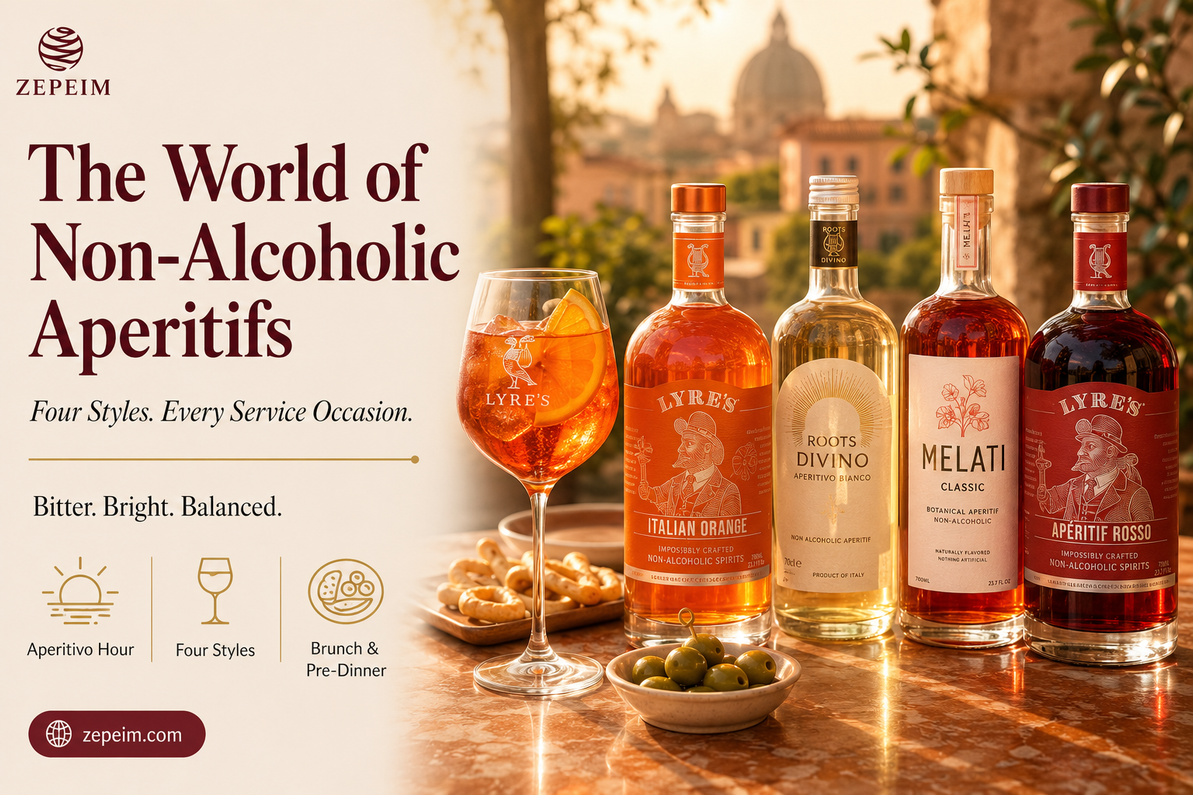
Exploring the World of Non-Alcoholic Aperitifs
The beverage manager of a boutique hotel in Boston's Back Bay walked her weekend team through the Sunday brunch service prep — Bellinis, mimosas, sparkling wine flights, and, this quarter for the first time, a dedicated non-alcoholic aperitivo cart. Three months earlier, her Sunday brunch had a single "non-alcoholic option" listed on the printed menu, and the guests who ordered it — designated drivers, pregnant guests, wellness-focused diners — had been getting an unmemorable spritz built with grapefruit juice and soda. The check averages on those tables told the story. When she added a real non-alcoholic aperitivo program — bitter orange, vermouth-style, botanical bittersweet options — those same tables started ordering two or three rounds instead of one. Her aperitivo hour, which she had launched the previous Fall as a Thursday-through-Sunday experiment, now regularly generated non-alcoholic pours at rates comparable to the alcoholic program at peer pricing. Aperitifs turned out to be the category where the non-alcoholic offer had the strongest natural fit — where the ritual, the presentation, and the pre-meal function of the drink translated cleanly across the alcohol line. This guide walks through the specific frameworks that make a non-alcoholic aperitif program work: the four major style categories, the service contexts where the format performs, the batching approach for volume service, and the pricing framework that captures full margin.
Why the Aperitif Category Is the Strongest Fit for Non-Alcoholic
Of every beverage category being reimagined in the non-alcoholic space, aperitifs may be the strongest natural fit. Aperitifs were never really about the alcohol. They were about the ritual — the bittersweet complexity, the light body, the appetite-stimulating structure, the shared moment before a meal or during an early evening. Every one of those characteristics translates cleanly across the alcohol line. A well-made non-alcoholic aperitif does not read as a substitute for a Spritz or a Negroni; it reads as a serious aperitif in its own right.
This is why non-alcoholic aperitifs consistently outperform other zero-proof categories on attach rate, guest satisfaction, and repeat-order metrics. It is also why the operators who have moved decisively — building aperitivo hour programs, adding non-alcoholic Spritz to Sunday brunch service, stocking multiple bittersweet options behind the bar for cocktail construction — are capturing significant new revenue segments their competitors are still leaving on the table.
What a Non-Alcoholic Aperitif Actually Is
A non-alcoholic aperitif is a beverage designed to stimulate the appetite and open a meal — built with the same botanical, bitter, and citrus building blocks as its alcoholic counterpart, but without ethanol. The category is defined by four consistent characteristics:
Bitterness structure. Real aperitifs — alcoholic or otherwise — are built on bitter compounds. Gentian, wormwood, cinchona, orange peel, quinine, and various bitter herbs give the category its defining edge. This is what separates a serious aperitif from a sweetened juice-based mocktail.
Botanical complexity. A layered blend of herbs, spices, roots, citrus peels, and sometimes floral or fruit distillates. The best non-alcoholic aperitifs carry the same aromatic depth as their alcoholic counterparts because they are built with the same categories of ingredients — just without the alcohol as a solvent.
Light body and low sweetness. Aperitifs are not dessert drinks. Sweetness is present but restrained; the balance leans toward bitter, dry, or bittersweet. This makes them appropriate as appetite-openers rather than palate-closers.
Serving format. Most non-alcoholic aperitifs are designed to be served chilled, often lengthened with soda, tonic, or non-alcoholic sparkling wine, and finished with citrus or herbal garnish. Proper stemmed glassware and considered garnish work are what elevate service from casual to serious.
Most Zepeim portfolio non-alcoholic aperitifs are labeled 0.0% ABV, though a few products (such as Lyre's Italian Orange) carry <0.5% ABV labeling. Always check individual product labeling and follow house policies for zero-tolerance service occasions.
The Four Style Categories of Non-Alcoholic Aperitifs
A serious non-alcoholic aperitif program covers four distinct style categories. Each anchors different cocktail templates and different service occasions. The Non-Alcoholic Aperitif & Digestif category centralizes the full range across all four styles.
|
Bitter Orange
Aperol-style · Spritz-forward
|
Vermouth-Style
Rosso & Bianco · Stirred cocktails
|
Bittersweet Botanical
Herbal · Modern craft
|
RTD Aperitivo
Ready-to-drink · Volume service
|
1. Bitter Orange (Aperol-Style)
The single most versatile category and the anchor of any non-alcoholic aperitif program. Bitter orange aperitifs replicate the vibrant, bittersweet, orange-forward character that defines the classic Italian Spritz. This is the workhorse for aperitivo hour, brunch service, poolside programs, and the most-ordered non-alcoholic cocktail template in North American bars in 2026 — the No-Proof Aperol Spritz. Anchor brand: Lyre's Italian Orange.
2. Vermouth-Style (Rosso & Bianco)
Non-alcoholic vermouth alternatives — both the darker, herbal-forward Rosso and the lighter, citrus-forward Bianco — unlock the entire stirred-cocktail vocabulary. The non-alcoholic Negroni, the zero-proof Manhattan, the low-and-slow aperitivo pour on the rocks. Vermouth-style aperitifs are the category that turns a non-alcoholic bar program from functional into serious. Anchor brands: Lyre's Aperitif Rosso, Roots Divino (Bianco and Rosso).
3. Bittersweet Botanical (Modern Craft)
A newer generation of non-alcoholic aperitifs built specifically for the zero-proof format — not attempting to replicate a specific alcoholic template, but instead building complex botanical layers that stand on their own. These pair well with modern craft cocktail programs and read as design-forward, brand-forward options for guests looking for something distinctive rather than a classic translation. Anchor brand: Melati Classic Botanical Aperitif.
4. RTD Aperitivo (Ready-to-Drink)
Canned and bottled ready-to-drink non-alcoholic Spritzes, Negronis, and aperitivo-style formats — critical for volume service occasions, poolside programs, hotel minibars, event pours, and retail grab-and-go merchandising. Anchor brands: Lyre's Italian Spritz, Lyre's Classico Sparkling RTD. See the Ready-to-Drink RTDs range for the full RTD portfolio.
Where Non-Alcoholic Aperitifs Deliver the Highest Service Value
Aperitivo Hour Programs
The single most direct application. Bars and restaurants running dedicated aperitivo hour programs — typically 4pm to 7pm — increasingly build the non-alcoholic offer into the primary menu rather than treating it as a secondary line. Non-alcoholic Spritz options on the aperitivo menu at peer pricing to alcoholic Spritzes capture the guest who was previously ordering only sparkling water during aperitivo hour. See our Bars & Lounges program guide for full aperitivo programming detail.
Brunch and Daytime Service
Brunch is one of the highest non-alcoholic conversion occasions in hospitality. Non-alcoholic Spritz, Bellini alternatives, and light aperitivo pours pair naturally with brunch food, land well with pregnant and family-service guests, and elevate the check average on tables that previously ordered only coffee or juice.
Pre-Dinner and Amuse-Bouche Service
Fine-dining restaurants running formal or semi-formal service increasingly offer a matched non-alcoholic aperitif alongside the amuse-bouche — light, bittersweet, palate-preparing. This is a moment where the ritual and function of the aperitif are on full display, and guests notice when the non-alcoholic option is genuinely considered. See our Restaurants program guide for restaurant-specific integration.
Pool and Terrace Programs
Hotel pool service and outdoor terrace programs are ideal contexts for non-alcoholic Spritz and RTD aperitivo formats. Guests spending the day at the pool are already moderating; a serious non-alcoholic offer gives them the ritual of the cocktail without the fatigue and heat sensitivity that alcoholic drinks bring in daytime sun. See our Hotels & Resorts program guide for poolside programming.
Catering and Event Service
Weddings, corporate galas, and hosted events benefit specifically from the aperitivo format because it works as a welcome pour that arrives with the same visual presence as a glass of Champagne but does not commit the guest to a full alcoholic serving. Half-bottle and RTD formats make execution across large guest counts operationally straightforward. See our Catering & Events program guide.
Batching Non-Alcoholic Aperitifs for Volume Service
One of the operational strengths of the non-alcoholic aperitif category is that most of the shelf-stable products in it batch cleanly for high-volume service without compromising quality. This is not universally true across non-alcoholic categories — fresh-citrus cocktails and shaken drinks still generally need to be built to order — but bittersweet aperitivo-style pours are naturally batch-friendly.
What batches well. Vermouth-style pours (Rosso or Bianco base), pre-mixed Negroni alternatives, and bittersweet Spritz bases can be pre-diluted, chilled, and drawn from batch bottles or bar wells during service. Melati Classic and Roots Divino both perform particularly well in batched form.
What to keep to-order. RTD-based Spritzes should be built and finished at the point of order to preserve carbonation and presentation. Citrus-forward pours (fresh orange, fresh grapefruit) need fresh juice at service. Any drink where the visual — a fresh garnish, a floating peel, a color layer — is part of the guest experience should be finished at the point of service.
This batching approach is how serious cocktail programs maintain execution speed on non-alcoholic during aperitivo rush without dragging on ticket times. For the fuller framework on batching within a bar cocktail program, see our recently published Non-Alcoholic Cocktail Programs for Bars guide.
The Margin Case for Non-Alcoholic Aperitifs
Aperitifs — alcoholic or non-alcoholic — have historically been one of the higher-margin categories in a beverage program because they command premium pricing, are served in smaller pours than table wine, and pair with light snacks that further lift the check. The non-alcoholic version of the category carries all of these same margin characteristics, with the additional benefit of the guest segment expansion effect.
A non-alcoholic Spritz priced at peer level to an alcoholic Spritz — typically $12 to $18 depending on venue and market — captures full retail on a guest who might otherwise have ordered still water. In an aperitivo hour service with 50–100 guests, this attachment lift compounds meaningfully. Programs that price the non-alcoholic Spritz at a discount to the alcoholic version leave real margin on the table with no offsetting demand benefit — the market has already validated peer pricing.
For the broader margin framework across the non-alcoholic category, see our Maximizing Margins with Non-Alcoholic Beverages guide.
Implementation Roadmap: Adding a Non-Alcoholic Aperitif Program
| Phase | Timing | Key Actions |
|---|---|---|
| Phase 1 — Sample & Taste | Weeks 1–2 | Request sample kit from Zepeim across all four aperitif style categories. Head bartender and beverage director taste through options. |
| Phase 2 — Curate | Weeks 3–4 | Select 3–5 anchor SKUs across bitter orange, vermouth-style, bittersweet botanical, and RTD categories. Match to primary service occasions. |
| Phase 3 — Menu Design | Weeks 5–6 | Write specs for 3–5 non-alcoholic aperitif cocktails, integrate into aperitivo hour, brunch, and pre-dinner menus. Set peer pricing. |
| Phase 4 — Team Training | Weeks 7–8 | Train bartenders and servers on product knowledge, batching protocol, and confident aperitivo scripting. Rehearse volume-service execution. |
| Phase 5 — Launch & Track | Week 9+ | Program goes live. Track attach rate during aperitivo hour, average ticket lift on brunch, guest feedback. Adjust menu placement and scripting based on data. |
Conclusion: The Category Worth Building First
If a bar or restaurant were choosing one non-alcoholic category to build seriously before all others, the aperitif category is the strongest starting point. It captures the ritual, presentation, and margin characteristics of the alcoholic version cleanly. It anchors aperitivo hour, brunch, and pre-dinner service occasions where non-alcoholic attach rates run highest. It batches cleanly for volume execution. And it opens the door to the wider non-alcoholic cocktail program by giving bartenders confidence in the category's most versatile building blocks — bitter orange, vermouth-style pours, and bittersweet botanicals.
The four-style framework in this guide — bitter orange, vermouth-style, bittersweet botanical, and RTD aperitivo — is what the strongest programs are building. Working with a specialist distributor whose portfolio spans all four categories makes the launch straightforward. From there, the rest of the non-alcoholic program builds outward naturally.
Explore the Program Guide That Fits Your Venue
Aperitif programs deliver value differently across venues. Zepeim's Beverage Program guides cover the specifics for each channel:
| Bars & Lounges → | Restaurants → | Hotels & Resorts → | Catering & Events → |
Ready to Build Your Non-Alcoholic Aperitif Program?
Apply for a Zepeim wholesale account to access the full curated portfolio of non-alcoholic aperitifs — Lyre's, Roots Divino, Melati, and the broader spirits & aperitivo range. Sommelier and mixologist consultation guides tier structure and cocktail spec design, sample kits enable pre-launch tasting across all four style categories, and case-tier volume discounts apply from the first order forward.
Apply for a Wholesale Account →Frequently Asked Questions
Recent Posts
-
Hidden Gems: Zero-Proof Champagne Alternatives
A senior wedding planner at a Manhattan events firm spent a January morning reviewing the previous …Aug 1st 2026 -
Exploring the World of Non-Alcoholic Aperitifs
The beverage manager of a boutique hotel in Boston's Back Bay walked her weekend team through the …Jul 29th 2026 -
Non-Alcoholic Cocktail Programs for Bars
The head bartender of a 40-seat cocktail bar in downtown Portland kept a paper notebook behind the …Jul 26th 2026