
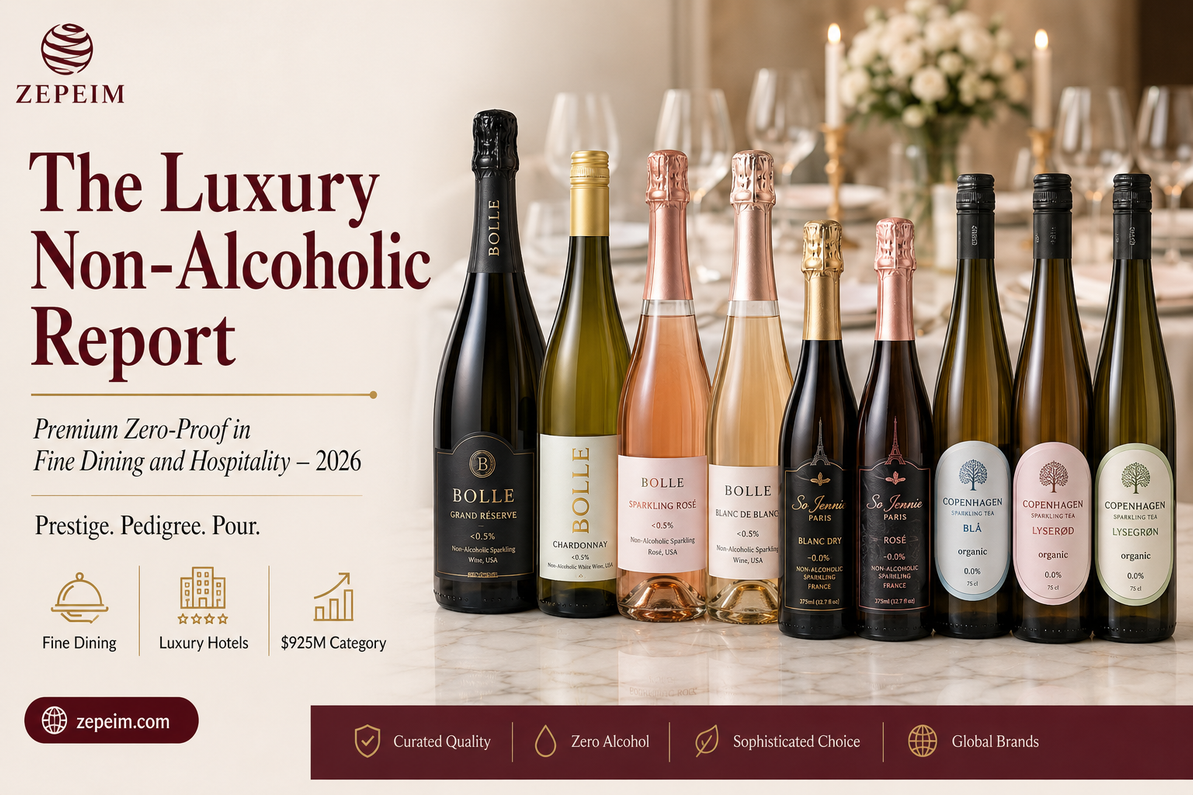
The Luxury Non-Alcoholic Beverage Report
The beverage director of a Forbes-rated five-star property in Los Angeles opened her strategy meeting for the year with a chart she had spent a week preparing. Across her three fine-dining outlets, her hotel bar, her poolside program, and her private-events division, one line on the chart pointed sharply upward — the percentage of premium guests requesting a non-alcoholic pour with genuine intention. Not a courtesy request for water, not an apologetic "I'm not drinking tonight," but an intentional order for something that matched the ambition of what everyone else at the table was drinking. The percentage had roughly doubled in eighteen months. Her existing offer — a small sparkling grape juice, an unmemorable non-alcoholic beer, and a housemade mocktail her bartender was tired of shaking — was falling short. Her question to the team was direct: what does the luxury non-alcoholic pour actually look like in 2026, and how quickly can we build one worthy of the property? This report is written to answer exactly that question — for beverage directors, F&B managers, luxury hotel owners, and members-only club operators asking the same one.
Executive Summary: The 2026 Prestige Non-Alcoholic Category
The luxury non-alcoholic beverage category has crossed a threshold. What was once a courtesy offering — sparkling grape juice on the wine list, a housemade mocktail for the pregnant guest — is now a strategic revenue category with its own reserve-tier brands, its own by-the-glass pricing framework, and its own guest segment paying peer prices to alcoholic pours. Three-Michelin-star restaurants, five-star hotels, members-only clubs, and prestige event venues are the operators leading the shift. The data confirms it: SpotOn's January 2026 restaurant menu analysis found a 47 percent year-over-year increase in non-alcoholic beverage additions to independent restaurant menus, with premium zero-proof pours emerging as the fastest-growing sub-segment.
This report walks through the specific shape of the luxury non-alcoholic category as it stands in 2026 — the market data, the guest expectations, the anchor brands driving Reserve-tier programs, the pricing framework that captures the revenue opportunity, and the implementation playbook for luxury hospitality operators building or refreshing programs in the year ahead.
The 2026 Market Reality for Luxury Hospitality
The market data underlying the 2026 shift is unambiguous. Two industry reports frame the picture most clearly.
|
+47%
YoY Growth in Restaurant NA Menu Additions (SpotOn, Jan 2026)
|
$925M
NA Off-Premise Sales, +22% YoY (NIQ, Aug 2025)
|
100+
Michelin Restaurants Pouring Premium NA
|
SpotOn's January 2026 report — drawing on restaurant menu data across the independent segment — documents a 47 percent year-over-year increase in non-alcoholic beverage menu additions, with the zero-proof and low-proof sub-category accounting for roughly a third of that growth. Independent restaurants are adding these beverages specifically to "hold price, drive attachment, and protect beverage profit margin" as the report frames it — this is not a courtesy category anymore; it is a margin defense strategy.
NIQ's August 2025 Beverage Alcohol Report puts a dollar figure on the shift: the non-alcoholic category reached $925 million in off-premise sales, up 22 percent year over year. IWSR — the global alcohol industry data authority — has begun describing no- and low-alcohol products as "a crucial growth driver for the future of U.S. beer," language that historically only applied to the largest structural shifts in the market.
Even more consequentially, adoption at the top of the hospitality market is accelerating. The James Beard Foundation's 2025–2026 Taste America tour now includes non-alcoholic partners as formal category participants — a signal to the entire fine-dining industry that premium NA has been institutionally recognized as a peer beverage category, not a specialty aside.
The "Prestige Pour": What Luxury Guests Actually Want
The luxury guest choosing a non-alcoholic pour in 2026 is not looking for a discount or a substitute. They are looking for what industry sommeliers now openly call the "prestige pour" — a bottle that feels intentional, elevated, and worth ordering in its own right. A pour that arrives with the same presentation ritual as a grand cuvée Champagne. A bottle that photographs well. A brand story worth telling the guest across the table. A price that respects the seriousness of the offering.
Luxury guests choose non-alcoholic pours for a wide range of reasons — pregnancy, wellness commitments, sober-curious lifestyle choices, cultural or religious observance, athletic training, executive-level performance discipline, or simply moderating on a given evening. What unites them is that they are paying luxury prices for their overall experience and they expect the non-alcoholic offer to reflect that.
The specific quality signals luxury guests look for are consistent: real cork, foil top, and glass bottles that present alongside Champagne without visual downgrade; a brand pedigree they can research and recognize (LVMH backing, Michelin restaurant placement, sommelier endorsement); production integrity (organic, minimal intervention, real fermentation techniques); and a flavor profile serious enough to hold up on a food pairing rather than reading as a sugary alternative.
The Reserve-Tier Brands Anchoring Luxury Programs in 2026
The luxury non-alcoholic category has consolidated around a small set of Reserve-tier anchor brands — each with the pedigree, production quality, and market recognition to sit credibly on a serious wine list or premium bar back. The Zepeim portfolio's Reserve (Luxury) tier selection centralizes the specific brands that anchor top-of-market programs. The most consequential in 2026:
French Bloom (France). LVMH-backed, 0.0% French organic sparkling. The single most recognizable pedigree in the luxury zero-proof category. Le Blanc and Le Rosé cuvées are now standard fixtures on Michelin-level tasting menus and five-star hotel by-the-glass programs. The natural anchor for any Reserve-tier program.
So Jennie Paris (France). Premium French sparkling rosé served in first-class airline cabins and five-star hotel lobby bars worldwide. Design-forward packaging that reads as a curated gift and pours as a serious wine. A frequent Reserve-tier choice at hospitality properties where guest experience is the central product.
Copenhagen Sparkling Tea (Denmark). Organic sparkling teas poured in over 100 Michelin-starred restaurants globally, including three-Michelin properties running dedicated non-alcoholic tasting flights. The category-defining choice for restaurants building sommelier-led pairing programs.
Prima Pavé (Italy). Award-winning Italian sparkling with multi-medal international recognition. Blanc de Blancs, Rosé Brut, and specialty formats appropriate for luxury dining, private events, and high-end retail merchandising.
BOLLE. The 93-point Sparkling Rosé and 91-point Blanc de Blancs anchor a strong American-produced luxury sparkling offer — designed specifically for by-the-glass programs and single-service occasions with full cork-and-cage presentation.
Kolonne Null (Germany). German precision non-alcoholic wines and sparkling — a serious complement to the French and Italian anchors for still and sparkling wine coverage at the Reserve tier.
Financial Impact: Revenue, Margin, and Guest Segment Expansion
The financial case for a Reserve-tier non-alcoholic program at a luxury property is stronger than most operators appreciate before they build one. Three specific revenue effects consistently show up in operator data:
1. Peer pricing capture. Reserve-tier non-alcoholic sparkling by-the-glass pours at luxury properties typically price at 85–100 percent of the equivalent alcoholic sparkling wine pour. Guests accept and expect this pricing because the ritual, presentation, and quality of the offering are peer to the alcoholic option. Programs that discount their non-alcoholic pour by 30–50 percent are leaving material revenue on the table with no corresponding demand benefit.
2. Attachment rate. Non-alcoholic guests who previously ordered still water are now ordering a paid Reserve-tier pour. This shift converts a $0 beverage line into a $20+ pour on the check, with strong margin. In a property serving thousands of covers weekly, the incremental revenue compounds meaningfully.
3. Guest segment expansion. Programs that credibly offer Reserve-tier non-alcoholic pours capture guests they were previously invisible to — the pregnant Michelin diner celebrating a milestone, the sober-curious executive taking a client to a five-star dinner, the culturally observant guest hosting a table at a private event. These guests were spending their money elsewhere. A serious non-alcoholic program brings them into the property.
For a broader framework on how non-alcoholic beverage programs contribute to hospitality margins across all tiers, see our Maximizing Margins with Non-Alcoholic Beverages guide.
Where Luxury Adoption Is Fastest in 2026
Michelin-Level Restaurants and Tasting Menu Programs
The single most visible adoption context. Three-Michelin properties are now running dedicated non-alcoholic tasting flights alongside their wine pairings, with sommelier-led selections and pour service ceremony matching the alcoholic version. See our detailed analysis in Why Michelin-Level Restaurants Are Adopting Non-Alcoholic Wine Pairings.
Five-Star Hotels and Resort Programs
Reserve-tier bottles anchoring minibar programs, welcome-amenity service, poolside lounge menus, and property-wide beverage lists. The Reserve-tier bottle has become part of the luxury hotel's standard pour vocabulary. See our Hotels & Resorts program guide for luxury property specifics.
Members-Only Clubs and Private Dining
Private dining clubs, country clubs, and members-only social clubs have moved decisively toward Reserve-tier non-alcoholic pours as part of their curated beverage offer. The member expectation is that the club matches or exceeds the standards they experience at the best restaurants and hotels — and a serious non-alcoholic offer is now part of that expectation.
Prestige Event Venues and Luxury Catering
High-end weddings, corporate galas, art openings, and hosted events at luxury venues increasingly build the non-alcoholic pour into the primary beverage service — often with matched half-bottle formats at each place setting for non-drinking guests. See our full framework on the half-bottle format in Half Bottles, Full Potential.
Luxury Hotel Bars and Lobby Lounge Programs
Reserve-tier non-alcoholic cocktails at hotel lobby bars, rooftop lounges, and property signature bars — often built with premium non-alcoholic spirits and executed to the same technical standard as the alcoholic classics. See our Bars & Lounges program guide for premium bar programming.
Implementation Roadmap for Luxury Hospitality Operators
| Phase | Timing | Key Actions |
|---|---|---|
| Phase 1 — Assessment | Weeks 1–2 | Audit current non-alcoholic offering across all outlets, measure guest request rate, identify Reserve-tier gaps, request sample kit from Zepeim. |
| Phase 2 — Curation | Weeks 3–4 | Sommelier-led tasting through Reserve-tier options, select 3–5 anchor SKUs across French, Italian, and sparkling-tea categories, finalize price positioning. |
| Phase 3 — Menu Design | Weeks 5–6 | Design dedicated non-alcoholic menu section with prestige presentation, structure by-the-glass and bottle pricing at peer level to alcoholic list, place first wholesale order. |
| Phase 4 — Team Training | Weeks 7–8 | Train sommeliers, servers, and bartenders on Reserve-tier brand stories, pairing logic, and pour service protocol. Rehearse guest presentation ceremony. |
| Phase 5 — Launch & Track | Week 9+ | Program goes live. Track pour rate, attachment rate, guest feedback, and quarterly revenue impact. Expand successful anchors and add seasonal specials. |
For a foundational framework on program building at any tier, see our companion guide How to Build a Non-Alcoholic Beverage Program for Your Restaurant or Bar, and for tier progression logic, our Three-Tier Playbook.
Conclusion: The 2026 Luxury Beverage Decision
The luxury non-alcoholic category has passed the point where operators can treat it as optional. The market data — 47 percent year-over-year restaurant menu growth, $925 million in off-premise sales up 22 percent, IWSR's structural growth categorization — confirms that this is a permanent category shift, not a passing trend. The guest expectation at the top of the market is that a serious non-alcoholic offer sits alongside the wine list, priced at peer level, presented with the same ceremony, and stocked with brands the guest can research and recognize.
For luxury hospitality operators, the decision framework is straightforward. Anchor the Reserve tier with French Bloom, Copenhagen Sparkling Tea, and So Jennie Paris. Add depth through Prima Pavé, BOLLE, and Kolonne Null. Price at peer level. Train the team to present with confidence. Track attachment rate and pour revenue quarterly. The operators who make this shift decisively are capturing revenue segments their competitors are still overlooking — and defining the luxury guest experience of the year ahead.
Explore the Program Guide That Fits Your Property
Zepeim's Beverage Program guides are written for the specific realities of each luxury hospitality channel:
| Restaurants → | Hotels & Resorts → | Bars & Lounges → | Catering & Events → |
Ready to Build Your Reserve-Tier Non-Alcoholic Program?
Apply for a Zepeim wholesale account to access French Bloom, So Jennie Paris, Copenhagen Sparkling Tea, Prima Pavé, BOLLE, Kolonne Null, and the full curated Reserve-tier portfolio. Sommelier consultation, sample kits, and case-tier volume discounts apply from the first order forward — with fulfillment from the Los Angeles warehouse to all 50 states.
Apply for a Wholesale Account →Frequently Asked Questions
Recent Posts
-
Hidden Gems: Zero-Proof Champagne Alternatives
A senior wedding planner at a Manhattan events firm spent a January morning reviewing the previous …Aug 1st 2026 -
Exploring the World of Non-Alcoholic Aperitifs
The beverage manager of a boutique hotel in Boston's Back Bay walked her weekend team through the …Jul 29th 2026 -
Non-Alcoholic Cocktail Programs for Bars
The head bartender of a 40-seat cocktail bar in downtown Portland kept a paper notebook behind the …Jul 26th 2026