
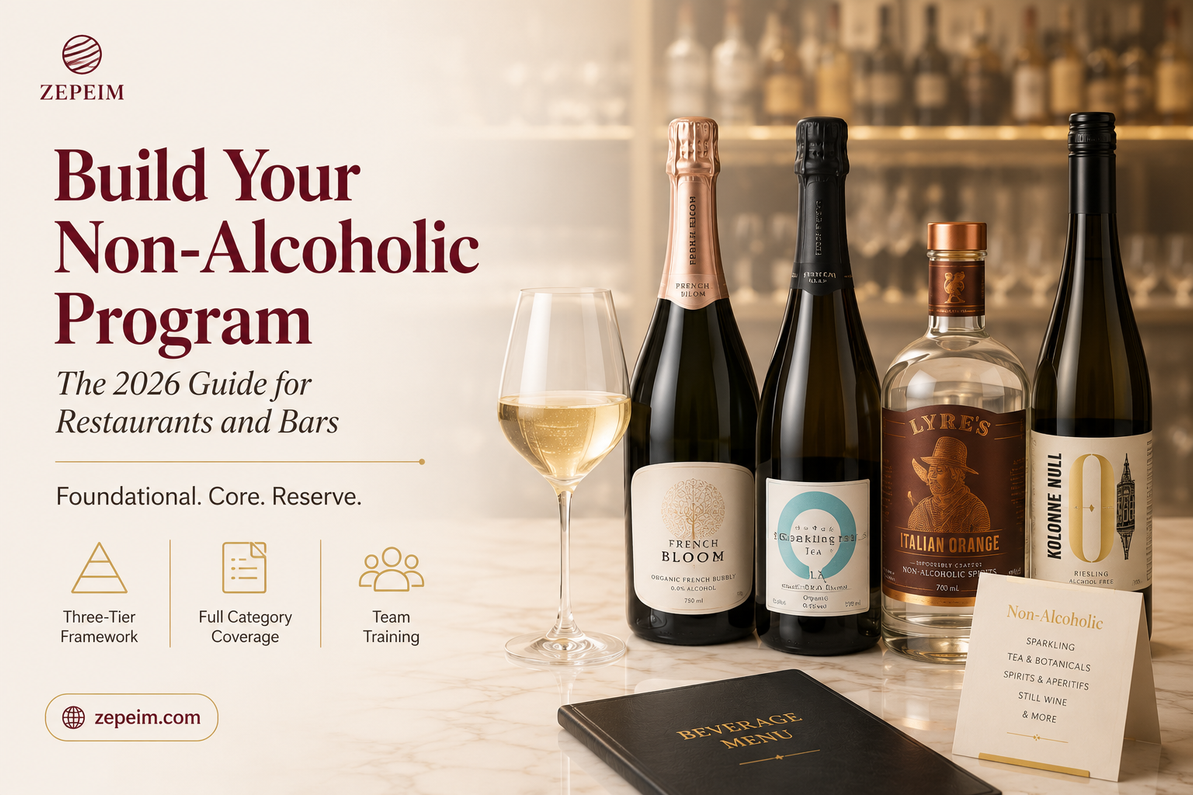
How to Build a Non-Alcoholic Beverage Program or Bar
The general manager of a 90-seat neighborhood restaurant in Brooklyn opened her Monday-morning planning meeting with a data point her beverage director had prepared over the weekend. Across the previous quarter, roughly one in five diners had ordered a non-alcoholic option at some point during their meal — a mocktail, a sparkling tea, a zero-proof pairing, or simply asking the server "what non-alcoholic options do you actually have?" The restaurant's current non-alcoholic offering was a soda gun, three bottled sodas, and a single "housemade" mocktail that took the bartender four minutes to build. She was losing an entire revenue category to inattention. What she needed was not another product to buy — it was a program. This guide is written for the operators sitting in her position. It walks through how to design, source, price, launch, and sell a non-alcoholic beverage program at your restaurant or bar in 2026 — the frameworks, the tiers, the product decisions, the operational realities, and the specific mistakes to avoid. It is the guide the strongest beverage programs are already using.
Why 2026 Is the Year Non-Alcoholic Programs Become Baseline Infrastructure
The non-alcoholic category has moved through three distinct phases over the past decade. In the mid-2010s, it was a curiosity — a mocktail on the menu, a housemade seasonal special, a single Seedlip bottle behind the bar. In the early 2020s, it became a considered addition — a small but real by-the-glass section, staff training around one or two brands, a handful of purposeful non-alcoholic cocktails alongside the classics. In 2026, it has crossed into baseline infrastructure. Restaurants and bars that do not have a genuine non-alcoholic program are now visibly behind, and their competitors are winning the guest segments that a serious non-alcoholic offer captures.
This shift is not driven by ideology. It is driven by measurable guest demand. Premium urban restaurants routinely see 10 to 25 percent of guests choose a non-alcoholic option when one is credibly offered. The buyer profile spans sober-curious young professionals, pregnant and nursing guests, wellness-focused patrons, culturally observant diners, designated drivers, and people simply choosing to drink less on a given evening. What unites them is that they all pay retail and expect a serious offer — not a courtesy garnish.
What "Program" Actually Means in the Non-Alcoholic Category
The word "program" is used casually across the industry, but in the context of non-alcoholic beverages it has a specific meaning. A program is not a single product decision or a menu section. It is an intentional set of choices across five dimensions that, taken together, define how your venue serves non-drinking and mindful-drinking guests.
1. Portfolio coverage. Which product categories your program spans — sparkling, still wine, spirits and cocktails, aperitifs, and adjacent formats — and which brands anchor each category.
2. Pricing tiers. How your non-alcoholic offering is stratified by price point — from approachable everyday pours through mid-tier serious options into Reserve-tier luxury selections that match your alcoholic top-shelf.
3. Service protocol. How the offering appears on your menu, how the server introduces it, how the bartender or sommelier presents it, and what glassware and pour service standards apply.
4. Training investment. What your team knows about the products — flavor profiles, pairing logic, brand stories — and how they translate that knowledge into recommendations that actually sell.
5. Merchandising and menu placement. Where the non-alcoholic section sits on the physical menu, how it is titled, whether it has its own dedicated section, and how visible it is to a guest who did not specifically ask.
The Foundational, Core, and Reserve Tier Framework
The strongest non-alcoholic programs are structured across three tiers — matched to the price stratification you already run on your alcoholic list. This framework gives every guest a serious option at their preferred price point and prevents the classic mistake of building a program that only serves one budget segment.
|
Foundational
Entry Tier · Everyday Pours
|
Core
Medium · A Serious List
|
Reserve
Luxury · The Statement
|
Foundational (Entry) — Where a Program Starts
The Foundational tier is what every serious non-alcoholic program needs at a minimum — approachable, well-priced pours that guests recognize and try without hesitation. This is where a sparkling option, a still wine choice, and a versatile non-alcoholic spirit for cocktail work belong. Foundational-tier bottles are your workhorses. They pour by the glass, mix into service cocktails, and serve as the safe recommendation when a guest is unsure what to order. Explore the Foundational tier selection for the specific brands that anchor this level.
Core (Medium) — A Serious List
The Core tier is where a program becomes a real list. This is where you add depth — multiple sparkling options across whites and rosés, a still wine complement, a genuine back-bar cocktail range, and specialty selections that reward a curious guest. Core-tier bottles are what a serious sommelier or beverage director walks a guest through when they say "tell me what you have." A Core tier signals that the venue takes the non-alcoholic offering seriously. See the Core tier selection for the brands that build this level.
Reserve (Luxury) — The Statement
The Reserve tier is what tells a guest — before they've even ordered — that your venue treats non-alcoholic as a peer category to its alcoholic list. LVMH-backed French sparkling. Danish organic sparkling teas featured in over 100 Michelin restaurants. Italian award-winning multi-medal sparkling. The Reserve tier is what makes an evening celebration possible without alcohol; it is what turns "I don't drink" from an apology into a genuine order. Explore the Reserve tier selection for the anchor bottles at this level.
For a deeper framework on tier structure and how to scale between them, see our Three-Tier Playbook: How to Grow a Non-Alcoholic Program.
Portfolio Coverage: What Categories Your Program Should Span
A serious non-alcoholic program covers the same conceptual ground as a serious alcoholic list, but with different products doing the work. The specific categories that matter:
Sparkling. The single most important category. A sparkling option is what makes celebration possible for non-drinking guests, and it is what most drinkers reach for when they want a non-alcoholic pour that reads as considered rather than default. This includes French sparkling, Italian sparkling, and sparkling teas — each with its own price tier. See our Non-Alcoholic Sparkling Wine category for the full range.
Still wine — white, red, and rosé. The by-the-glass complement for guests eating a full meal. Still non-alcoholic wine has matured significantly over the past three years; the best selections now hold their own on food pairings rather than reading as substitutes. Browse the Non-Alcoholic Wine range for the full still-wine portfolio.
Non-alcoholic spirits and cocktail alternatives. The back-bar toolkit for building non-alcoholic cocktails that mirror the classics — gin substitutes, whiskey substitutes, aperitifs, vermouth, and bitters. Programs that skip this category force their bartenders to build every non-alcoholic cocktail from scratch, which does not scale. See the Non-Alcoholic Spirits, Mixers & Aperitifs range for the back-bar essentials.
Ready-to-drink (RTD) formats. Canned non-alcoholic cocktails and single-serve formats — essential for volume service occasions, poolside programs, event pours, and grab-and-go retail. Explore the Ready-to-Drink RTDs range.
Specialty and design-forward brands. Beyond the core categories, a program benefits from one or two distinctive brands that stand out visually or thematically — the bottle a curious guest asks about, the brand that gets photographed, the option that signals your program has depth. See Notable brands for design-forward selections.
Pricing and Margin: How to Set the By-the-Glass and Bottle Rates
A common mistake in early non-alcoholic programs is under-pricing — treating the non-alcoholic pour as a discount option rather than a peer to the alcoholic list. This mistake is expensive and unnecessary. Non-alcoholic beverage guests overwhelmingly expect and accept peer pricing to alcoholic pours because the ritual, presentation, and quality of the offering are peer to the alcoholic version. The premium non-alcoholic bottle sitting behind your bar cost the guest roughly what the sparkling wine bottle cost — they should pay accordingly for the pour.
By-the-glass pricing. Most successful programs price a non-alcoholic sparkling pour at 85–100 percent of the equivalent by-the-glass sparkling wine rate. A non-alcoholic wine pour typically sits at 75–90 percent of the equivalent alcoholic pour. Bottle pricing for the non-alcoholic list should be structured at the same margin percentage as the alcoholic list — not discounted.
Cocktail pricing. A serious non-alcoholic cocktail — built with non-alcoholic spirits, fresh ingredients, and the same technique as an alcoholic cocktail — should be priced identically to the alcoholic version. The labor and ingredient cost are comparable, and the guest is receiving the same experience.
For a deeper look at margin optimization across the non-alcoholic category, see our Maximizing Margins with Non-Alcoholic Beverages guide, and for the financial case at fine-dining venues specifically, our 2026 Luxury Non-Alcoholic Beverage Report.
Team Training: The Difference Between Stocking and Selling
A serious non-alcoholic program that no one on your team can articulate does not sell. This is the most common failure mode across the industry — the venue orders the bottles, prints the menu, and then loses the revenue because servers and bartenders default to the same tired soda-or-sparkling-water script when a guest declines alcohol.
Training investment for a non-alcoholic program covers four areas: (1) brand stories and flavor profiles so servers can describe each option confidently; (2) pairing logic tied to your kitchen's menu so recommendations feel considered; (3) service protocol — glassware, presentation, pour standards — so the offering visually matches the ambition of the list; and (4) confident scripting so team members can suggest the non-alcoholic option proactively rather than waiting to be asked.
For a full framework on staff training specifically, see our Train Your Staff to Sell Non-Alcoholic Drinks With Confidence guide.
Implementation Roadmap: From Decision to Launched Program
| Phase | Timing | Key Actions |
|---|---|---|
| Phase 1 — Discovery | Weeks 1–2 | Assess current non-alcoholic offering, review sales data on existing NA pours, define target program tier structure, request sample kit from Zepeim. |
| Phase 2 — Curation | Weeks 3–4 | Taste through samples with beverage director and sommelier consultation, finalize tier structure, select 4–8 anchor SKUs across sparkling, still, spirits, and RTD categories. |
| Phase 3 — Sourcing | Weeks 5–6 | Place first wholesale order through Zepeim, confirm delivery timeline, prepare storage and back-bar space, set opening pricing and menu structure. |
| Phase 4 — Training | Weeks 7–8 | Train front-of-house and back-of-house team on brand stories, pairing logic, service protocol, and confident scripting. Print new menu with dedicated NA section. |
| Phase 5 — Launch | Week 9 | Program goes live. Track NA pour rate, guest feedback, and by-the-glass sell-through daily. Adjust menu placement and scripting based on early signals. |
| Phase 6 — Optimize | Weeks 10+ | Quarterly review of NA revenue as percentage of total beverage sales, expand successful anchor SKUs, add Reserve tier if program demonstrates traction, refresh menu seasonally. |
The Five Most Common Non-Alcoholic Program Mistakes to Avoid
Across a decade of working with U.S. restaurant and bar operators, five mistakes appear repeatedly in programs that never reach their potential.
1. Treating the non-alcoholic offer as an afterthought. Programs that survive on a single non-alcoholic sparkling and a handful of housemade mocktails fail to capture the guest segment that actually pays for a serious offer. Depth signals seriousness.
2. Hiding the non-alcoholic section on the menu. A dedicated section — appropriately positioned, honestly titled, visually parallel to the wine section — dramatically outperforms a small footnote at the bottom of the beverage list.
3. Under-pricing the pour. Discount pricing signals to the guest that the offering is a discount product. Peer pricing communicates that the offering is a peer product.
4. Skipping staff training. The best non-alcoholic bottle behind your bar sits idle if the server does not know how to describe it or the bartender does not know what to pair with it.
5. Choosing brands without curatorial guidance. The non-alcoholic category has hundreds of brands of widely varying quality. Working with a specialist distributor whose portfolio is already curated protects you from the SKUs that do not deliver.
Conclusion: The 2026 Program Decision
A serious non-alcoholic program is no longer an optional differentiator for restaurants and bars — it is a baseline expectation for the guest segments that are increasingly driving urban dining and drinking spend. The venues building real programs in 2026 are capturing meaningful additional revenue, expanding their guest base into segments they were previously invisible to, and signaling to every guest that walks in that the operation is paying attention.
The framework in this guide — Foundational, Core, and Reserve tiers structured across sparkling, still, spirits, and RTD categories, with matched training investment and peer pricing — is what the strongest programs are already using. Working with a specialist distributor who has done the curatorial work makes the launch straightforward. The rest is execution.
Explore the Program Guide That Fits Your Venue
Restaurants and bars serve different guest occasions and require different program structures. Zepeim's Beverage Program guides are written for the specific realities of each channel:
| Restaurants → | Bars & Lounges → | Hotels & Resorts → | All Programs → |
Ready to Build Your Restaurant or Bar Program?
Apply for a Zepeim wholesale account to access the full curated portfolio of premium non-alcoholic sparkling, wine, spirits, and RTD formats. Sommelier consultation guides tier structure, sample kits enable pre-launch tasting, and mix-and-match volume discounts apply across every brand and format from the first order forward.
Apply for a Wholesale Account →Frequently Asked Questions
Recent Posts
-
Hidden Gems: Zero-Proof Champagne Alternatives
A senior wedding planner at a Manhattan events firm spent a January morning reviewing the previous …Aug 1st 2026 -
Exploring the World of Non-Alcoholic Aperitifs
The beverage manager of a boutique hotel in Boston's Back Bay walked her weekend team through the …Jul 29th 2026 -
Non-Alcoholic Cocktail Programs for Bars
The head bartender of a 40-seat cocktail bar in downtown Portland kept a paper notebook behind the …Jul 26th 2026