
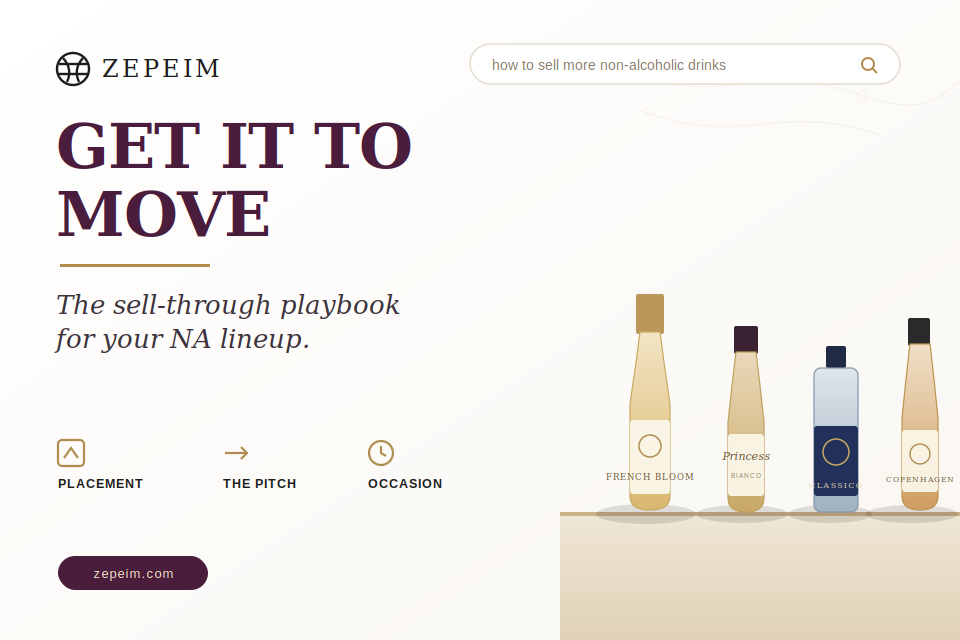
Stocking it was the easy part: how to sell through your non-alcoholic lineup
The cases arrived. The brands are good. The invoice is paid. And three months later, the reorder conversation becomes "it didn't really sell." But here is what usually happened: it was never really sold. The bottles went onto a shelf or into a cooler, and nothing changed about how the venue offered them. Stocking a non-alcoholic lineup is the easy part — the part anyone can do with a purchase order. Selling through it is a different discipline, and it comes down to three levers most operators never deliberately pull.
Stocking Is the Start, Not the Finish
A purchase order is a bet that product will move. Too often the bet is placed and then abandoned — the assumption being that a good brand sells itself. It doesn't. The single biggest factor in whether a non-alcoholic program reorders or stalls is rarely the label on the bottle. It is whether the venue changed anything about where the product sits, how it's offered, and the moment it's suggested. Those are the three levers below. Applied deliberately, and one at a time, they turn a static shelf into a category that earns its place — and its next order.
|
3
Levers That Move Product
|
1
Variable to Change at a Time
|
2 wks
To Read Each Result
|
Lever One — Put It Where the Decision Happens
The most common reason a non-alcoholic product underperforms isn't the product. It's that the guest never had a real chance to choose it. A bottle in the back of the cooler, an option buried at the bottom of a fifth menu page, a shelf facing at ankle height — none of these put the choice in front of the person at the moment they are deciding. Move it to where the decision is being made:
On-premise: a dedicated by-the-glass line, a short "zero-proof" section on the cocktail menu, a tent card on the table, or simply the server's first suggestion. Visibility at the point of order beats depth of selection.
Behind the bar: keep one or two anchors within arm's reach of the well, not in the back fridge. If the bartender has to walk for it, it won't get offered during a rush.
Retail: eye-level facings and a clearly signed set. The non-alcoholic shopper is often scanning quickly — a section that reads as intentional outsells a few bottles scattered among the alcohol.
Lever Two — Give Your Team One Line to Say
Staff sell what they can describe in a sentence. A long explanation of dealcoholization, or a hedge ("it's, um, like a non-alcoholic wine?"), kills momentum. Hand the floor and bar a single, confident line they can deliver without thinking. Lines that work share a pattern: they frame the drink as a real choice, not a consolation. "Same ritual, none of the alcohol." "A proper drink for whoever's driving." "It pairs with the course, not just the occasion." The goal is for the offer to land as an upgrade to the guest's evening, because that is what it is.
Offer it unprompted. "Can I start you with something — with or without alcohol?" normalizes the choice for the whole table and routinely surfaces a guest who wanted it but wouldn't have asked.
Let staff taste it. A team that has tried the product recommends it with conviction. A five-minute pre-shift pour does more for sell-through than any shelf talker.
Lever Three — Lead With the Occasion, Not the Absence
The strongest framing for non-alcoholic drinks isn't "no alcohol" — it's the moment the drink is perfect for. People reach for these products for dozens of reasons that have nothing to do with abstaining, and naming the occasion turns a niche into an everyday sale.
The early-week diner who wants something special on a Tuesday without a heavy night. The designated driver who's tired of soda water and a lime. The daytime event — a lunch, a shower, a corporate booking — where a celebratory pour shouldn't mean alcohol.
The guest taking a night off who still wants to hold a beautiful glass and feel part of the table. The pregnant guest, the athlete, the sober-curious regular — all of whom remember the venue that made them feel catered to, not accommodated. Build the occasion into the menu language and the staff pitch, and the category stops competing with alcohol for the same dollar — it captures spend that would otherwise have walked out as tap water.
Match the Range to the Room
Sell-through is easier when the range fits the venue. A few well-chosen products in the right tier outperform a long, unfocused list. Zepeim organizes the catalog into three program tiers precisely so the lineup matches the room it's poured in — and so the natural next step, once a lineup is moving, is one tier up rather than more of the same.
| Tier | Best For | What It Delivers |
|---|---|---|
| Foundational (Entry) | Bars, casual restaurants, by-the-glass programs | Easy-to-understand, fast-moving favorites where velocity matters most |
| Core (Medium) | Upscale restaurants, cocktail programs, curated bottle shops | The most relevant international brands, with real merchandising appeal |
| Reserve (Luxury) | Fine dining, luxury hotels, tasting menus | Complex, conversation-starting bottles that are part of the experience |
A Simple Diagnostic
When sell-through stalls, the instinct is to blame the product and quietly drop it. Before you do, run the three levers against the lineup — the answer is almost always in one of these rows.
| If you're seeing… | The lever to check | The fix |
|---|---|---|
| Guests don't know you carry it | Placement | Move it to the point of decision — menu, by-the-glass, eye-level facing |
| Staff don't bring it up | The pitch | One line to say, and a pre-shift taste so they mean it |
| It's offered but not chosen | Occasion | Reframe around the moment, not the absence of alcohol |
| It sells, but the range feels off | Tier | Right-size to the venue; consider one tier up |
One thing at a time: if you're trying to lift sell-through, change one variable — placement, pitch, or occasion framing — and watch it for two weeks. When all three move at once, you learn nothing about which one mattered.
Build a Program That Actually Moves
Zepeim helps restaurants, bars, hotels, clubs, and retailers across the country build non-alcoholic lineups that sell through — and grow them tier by tier. Explore the program guides by venue type, or apply for a wholesale account to access the full curated portfolio with mix-and-match volume pricing and fast nationwide fulfillment from Los Angeles.
Explore Beverage Programs → Apply for a Wholesale Account →Frequently Asked Questions
Recent Posts
-
Hidden Gems: Zero-Proof Champagne Alternatives
A senior wedding planner at a Manhattan events firm spent a January morning reviewing the previous …Aug 1st 2026 -
Exploring the World of Non-Alcoholic Aperitifs
The beverage manager of a boutique hotel in Boston's Back Bay walked her weekend team through the …Jul 29th 2026 -
Non-Alcoholic Cocktail Programs for Bars
The head bartender of a 40-seat cocktail bar in downtown Portland kept a paper notebook behind the …Jul 26th 2026