
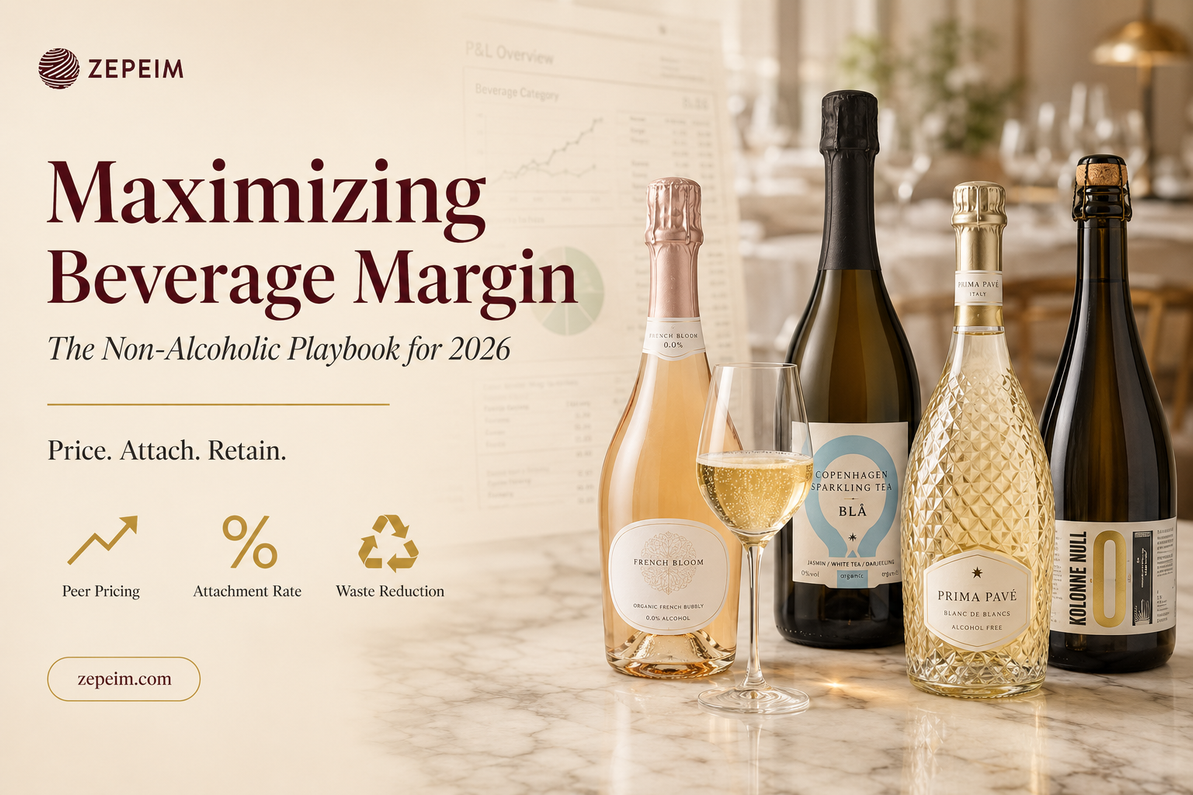
Maximizing Margins with Non-Alcoholic Beverages
The owner of a three-location restaurant group in Chicago sat down with her CFO on a January Monday to review the previous year's beverage program P&L. The pattern across all three properties was consistent and troubling: total covers were up, average check size was flat, and beverage revenue as a percentage of total sales had slipped by nearly two points. Wine and cocktail attach rates had softened. What her CFO surfaced next surprised her — the fastest-growing line item across all three P&Ls was not a wine SKU or a spirit brand. It was the non-alcoholic beverage category. Guests were ordering more of it, paying peer prices for it, and driving the strongest incremental margin in the beverage program. Her existing non-alcoholic offer — three bottled sodas, one sparkling grape juice, and a housemade mocktail her bar team was tired of building — was capturing a fraction of the demand that was actually walking through the door. The strategic decision she made in that meeting was to redesign the beverage program with non-alcoholic as a primary margin lever rather than a courtesy afterthought. Within two quarters, her beverage margin had recovered to the previous year's level and was trending upward. This guide walks through the specific frameworks that made that recovery possible — the ones the strongest restaurants, bars, and hospitality operators are using in 2026 to protect and grow beverage margin with the non-alcoholic category.
Executive Summary: Why Non-Alcoholic Is Now a Primary Margin Lever
The non-alcoholic beverage category has become one of the most important margin protection tools available to restaurant and bar operators in 2026. This is not a repositioning exercise or a wellness statement — it is a financial one. SpotOn's January 2026 restaurant menu analysis found a 47 percent year-over-year increase in non-alcoholic beverage additions among independent restaurants, with the category specifically credited by operators as a way to "hold price, drive attachment, and protect beverage profit margin" as alcohol sales soften across urban dining.
This guide walks through the four levers that operators are using to capture that margin: pricing strategy (peer pricing rather than discounted), attachment rate (converting $0 water orders into paid pours), cost structure (where non-alcoholic beats alcoholic on the P&L), and format strategy (waste reduction through single-service formats). Together, these levers turn a category previously treated as a courtesy line item into one of the strongest contributors to beverage margin performance.
Why Beverage Margin Is Under Pressure in 2026
The margin compression showing up across restaurant and bar P&Ls in 2026 has three converging causes. Understanding them is important because they shape which margin recovery strategies actually work.
1. Structural decline in alcohol consumption. Younger consumers are drinking less. Sober-curious lifestyles have moved from cultural niche to mainstream. Wellness-oriented workplace and social norms have made moderation a default rather than an exception. IWSR — the global alcohol industry data authority — now describes no- and low-alcohol beverages as "a crucial growth driver" for the future of U.S. beer, using language previously reserved for structural, permanent category shifts. Operators who continue to plan for previous decade's alcohol attach rates are planning for a market that no longer exists.
2. Wine list fatigue. The by-the-glass wine program that anchored beverage margin for decades is under pressure. Younger diners are less committed to bottle service, more likely to want a single glass or a non-wine option, and less responsive to sommelier upsell scripts that assumed alcoholic pours as the default. The wine list is still the anchor — but it is no longer the whole story.
3. Cocktail cost pressure. Premium spirit costs, garnish inflation, and labor pressure on complex cocktails have compressed cocktail margins even as menu prices have held. Programs still building every non-alcoholic option from scratch as a housemade mocktail are absorbing the same labor cost with a fraction of the ticket average — the worst of both worlds.
The Non-Alcoholic Margin Advantage
The specific reason non-alcoholic beverages contribute strongly to margin recovery is that they carry a set of structural cost advantages over alcoholic beverages while capturing peer retail pricing. The advantages are worth understanding in detail:
|
+47%
Restaurant NA Menu Additions YoY (SpotOn 2026)
|
85–100%
Peer BTG Price vs Alcoholic Pour
|
10–25%
Guests Choosing NA When Credibly Offered
|
No ABV tax exposure. Non-alcoholic beverages are not subject to the alcohol excise taxes, state licensing fees, and regulatory overhead that ride on every alcoholic pour. This does not directly show up on your P&L as a line item — but it is a structural cost that operators absorb into alcoholic beverage pricing and cannot avoid.
Simpler compliance and distribution. Non-alcoholic beverages ship nationwide without the state-by-state licensing complications that constrain alcoholic distribution. Programs can source from a single specialist distributor rather than navigating a patchwork of state-controlled alcohol wholesalers. This reduces sourcing costs and simplifies inventory management.
Peer retail pricing capture. The premium non-alcoholic pour at your venue can be priced at 85–100 percent of the equivalent alcoholic pour. The guest expects and accepts this because the presentation, ritual, and quality of the offering are peer to the alcoholic version. Programs that discount their non-alcoholic pour by 30–50 percent are leaving margin on the table with no offsetting demand benefit.
Longer shelf life. Most premium non-alcoholic bottles have a shelf life of 12–24 months from bottling, comparable to or better than typical still and sparkling wine turnover cycles. Inventory holding cost is manageable, and back-bar depth can be built without spoilage concerns.
Four Pricing Strategies That Capture Full Margin
1. Peer Pricing to Alcoholic Pours
The single most consequential pricing decision an operator makes with a non-alcoholic program. Reserve-tier non-alcoholic sparkling by-the-glass pours should be priced at 85–100 percent of the equivalent alcoholic sparkling wine pour. Non-alcoholic still wine pours should be priced at 75–90 percent of the equivalent alcoholic pour. Non-alcoholic cocktails should be priced identically to their alcoholic versions. This is the price point the market has already validated at the top of the hospitality segment — the venues doing this successfully are not seeing demand pushback, they are seeing peer pricing capture at strong margin.
2. Tiered Structure Matching Your Alcoholic List
Every alcoholic list runs across price tiers — house pours, mid-tier by-the-glass options, and premium/Reserve selections. Non-alcoholic programs should mirror the same structure, with Foundational, Core, and Reserve tiers matched to the same price stratification. This gives every guest a serious non-alcoholic option at their preferred price point and prevents the common failure mode of building a single-price program that captures only one segment. Zepeim's tier pages consolidate the specific brand assortments at each level: Foundational (Entry), Core (Medium), and Reserve (Luxury).
3. Non-Alcoholic Pairing Flights
Restaurants running tasting menus increasingly offer a dedicated non-alcoholic pairing flight alongside the wine pairing — priced separately, presented with the same sommelier-led ceremony, and often within 15–25 percent of the wine pairing price. This is a strong margin capture technique because it converts a guest who might otherwise have skipped the pairing entirely into a full-ticket order.
4. Bottle Service and Curated Bundles
Full-bottle service on premium non-alcoholic sparkling — priced at peer level to alcoholic bottle service — is a strong margin capture at celebration, private event, and hosted dining occasions. Curated bundle pricing (three-bottle progression flights, matched non-alcoholic sets for private dining rooms, event packages) allows operators to build higher-ticket configurations at strong margin.
Attachment Rate: Turning Zero-Revenue Guests into Paid Pours
The single largest margin opportunity in a non-alcoholic program is not price positioning — it is attachment rate. Guests who previously ordered still water, tap water, or a soda gun pour with dinner are now available to convert into a paid Reserve-tier or Core-tier non-alcoholic pour worth $15 to $25. This is not incremental margin on an existing beverage line — it is entirely new beverage revenue that did not previously exist on the ticket.
Premium urban restaurants and bars now routinely report 10 to 25 percent of guests choosing a non-alcoholic option when a credible program is offered. In a 90-seat restaurant serving 200 covers a night, this represents 20 to 50 additional paid beverage tickets per service — attached to guests who previously contributed no beverage revenue at all.
Attachment rate depends on three specific factors: (1) menu visibility — a dedicated non-alcoholic section, appropriately positioned, honestly titled; (2) staff scripting — servers and bartenders trained to suggest the non-alcoholic option proactively rather than waiting to be asked; and (3) tier structure — offering options at multiple price points so no guest is pushed into a single choice above or below their comfort level.
For a deeper framework on how staff training converts stocked bottles into sold pours, see our guide Train Your Staff to Sell Non-Alcoholic Drinks With Confidence.
Format Strategy: Waste Reduction as Margin Recovery
Open-bottle waste is one of the least-appreciated margin drains in a beverage program. Sparkling wine and sparkling non-alcoholic bottles that have been opened for a single pour and cannot be finished before quality degradation compound quickly across a service — and the discarded volume comes out of your beverage margin directly.
The margin solution is format strategy. Adding 375ml half-bottle formats to your Reserve and Core tier programs eliminates open-bottle waste on single-service occasions — minibar amenity service, tasting flights, single-diner service, and celebration room-service moments. A 375ml bottle used for a single-service pour delivers full presentation value with near-zero waste. Programs that run matched 750ml and 375ml SKUs of their flagship non-alcoholic sparkling brands typically see waste ratios drop from 30–40 percent on 750ml single-service pours to under 5 percent on 375ml equivalents.
For the full framework on when the format switch delivers the strongest margin impact, see our companion guide Half Bottles, Full Potential: Why 375ml Formats Are Good for Business.
Implementation: A Margin-First Program Rollout
| Phase | Timing | Margin Actions |
|---|---|---|
| Phase 1 — Audit | Weeks 1–2 | Measure current NA attachment rate, calculate open-bottle waste ratio, benchmark alcoholic BTG pricing, identify tier gaps. |
| Phase 2 — Tier Structure | Weeks 3–4 | Match Foundational, Core, and Reserve tiers to your alcoholic price structure. Select 4–8 anchor SKUs across tiers. |
| Phase 3 — Pricing | Weeks 5–6 | Set peer BTG and bottle pricing to alcoholic list. Design pairing flight pricing. Set attachment rate targets. |
| Phase 4 — Training | Weeks 7–8 | Train FOH team on proactive scripting, tier positioning, and pairing suggestions. Rehearse presentation ceremony. |
| Phase 5 — Launch & Track | Week 9+ | Track attachment rate, waste ratio, pour revenue, and beverage-margin percentage weekly. Adjust menu placement and scripting based on data. |
For a foundational framework on program building, see How to Build a Non-Alcoholic Beverage Program for Your Restaurant or Bar, and for the Reserve-tier revenue framework specifically, our Luxury Non-Alcoholic Beverage Report.
Conclusion: The Margin Case Is Now Structural
Beverage margin recovery in 2026 is no longer a question of tightening alcoholic pour costs or trimming cocktail garnish spend. The margin opportunity that matters is the non-alcoholic category — a structural shift documented by SpotOn, NIQ, and IWSR data, and now visible on the P&Ls of the operators who have moved decisively.
The four levers — peer pricing, tiered structure, attachment rate, and format-driven waste reduction — work together. Operators who apply all four report the strongest results. Programs that pilot with a single lever (typically pricing) see partial results but leave the majority of the margin opportunity uncaptured. The strongest performing programs in the year ahead will be the ones that treat non-alcoholic as a peer beverage category with a peer margin structure, and build the program accordingly.
Explore the Program Guide That Fits Your Venue
Different venues have different margin recovery priorities. Zepeim's Beverage Program guides cover the specifics for each channel:
| Restaurants → | Bars & Lounges → | Hotels & Resorts → | All Programs → |
Ready to Turn Non-Alcoholic Into a Margin Lever?
Apply for a Zepeim wholesale account to access the full curated portfolio across Foundational, Core, and Reserve tiers — with sommelier consultation on tier structure, sample kits for tasting-driven curation, and case-tier volume discounts that apply across every brand and format. Nationwide fulfillment from the Los Angeles warehouse to all 50 states.
Apply for a Wholesale Account →Frequently Asked Questions
Recent Posts
-

Hidden Gems: Zero-Proof Champagne Alternatives
A senior wedding planner at a Manhattan events firm spent a January morning reviewing the previous …Aug 1st 2026 -
Exploring the World of Non-Alcoholic Aperitifs
The beverage manager of a boutique hotel in Boston's Back Bay walked her weekend team through the …Jul 29th 2026 -
Non-Alcoholic Cocktail Programs for Bars
The head bartender of a 40-seat cocktail bar in downtown Portland kept a paper notebook behind the …Jul 26th 2026