
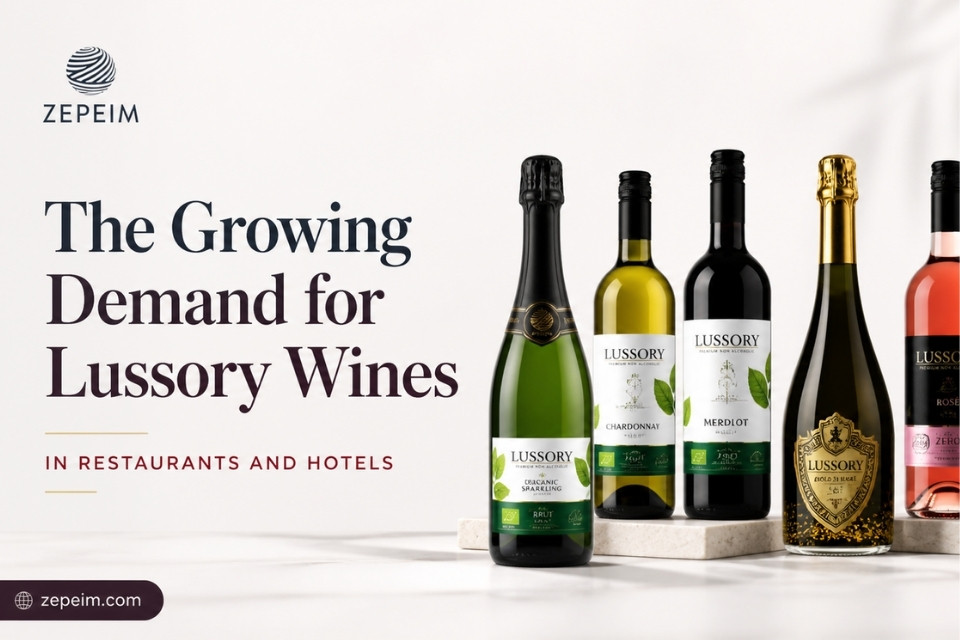
The Growing Demand for Lussory Wines in Restaurants and Hotels
In a quiet dining room in Midtown Manhattan, a sommelier sets down a bottle of Spanish wine at a table of four. The label is elegant. The pour is deep ruby — rich with the promise of Merlot. One guest looks up and asks, “Is this the zero-proof option?” The sommelier nods. What follows is not compromise. It is craft.
That scene — once unimaginable in fine dining — is now playing out across the United States. And at the center of it, with growing frequency, is Lussory — a premium non-alcoholic wine brand from La Mancha, Spain, distributed exclusively for the U.S. hospitality market through Zepeim.
Executive Summary
The demand for premium non-alcoholic wine in U.S. restaurants and hotels has shifted from a niche accommodation to a mainstream expectation. Lussory — crafted in Spain from varietals including Tempranillo, Merlot, Airén, and Chardonnay — has emerged as one of the most versatile, operator-trusted non-alcoholic wine brands available to the hospitality sector today.
Distributed nationally through Zepeim, the Lussory portfolio addresses the full spectrum of wine service: still reds, still whites, rosé, sparkling, organic-certified, and even a luxury 24-karat gold sparkling expression. This report examines why demand is accelerating, what that means for restaurant and hotel operators, and how the Lussory line-up translates directly into revenue opportunity.
|
34%
U.S. adults who actively reduced alcohol consumption in 2025
|
$1.7B+
Projected U.S. non-alcoholic beverage market value by 2028
|
0.0%
ABV across the core Lussory portfolio — true zero-proof
|
Market Insight: The Non-Alcoholic Wine Surge Is Not a Trend — It’s a Structural Shift
The rise of non-alcoholic wine is not driven by a single consumer segment. It spans Millennials and Gen Z who drink alcohol less frequently than any prior generation, health-conscious professionals who track nutrition and wellness metrics, pregnant and postpartum guests, Muslim consumers seeking Halal-certified options, and sober-curious diners who want the sophistication of wine without the intoxication.
What is changing — critically — is the quality bar. Early-generation non-alcoholic wines were overly sweet, thin-bodied, and poorly received by guests with wine knowledge. That era is over. Modern production technology, particularly low-temperature vacuum distillation and spinning cone column dealcoholization, now allows winemakers to remove alcohol without stripping the varietal character, aroma complexity, or structural integrity of the wine.
Lussory is a direct beneficiary of this technological leap. Produced in La Mancha — one of Spain’s most storied wine regions — and dealcoholized using cold-chain processes that preserve the grape’s natural expression, Lussory wines deliver an experience that surprises even skeptical sommeliers.
Key insight: Operators who added a non-alcoholic wine option to their by-the-glass program in 2024–2025 reported that guests who ordered it rarely treated it as a second choice. For a growing number of diners, it was the first choice — the option they had been waiting to be offered.
How Restaurants and Hotels Are Rethinking the Wine List
For decades, the standard hospitality approach to non-drinking guests was reactive: “We can do sparkling water or a soda.” That model is now a liability. In 2026, a guest who does not drink alcohol expects to be accommodated with the same level of intentionality applied to the wine list itself.
Leading hotel beverage directors and restaurant sommeliers are making three structural changes:
- Dedicated zero-proof wine sections: Rather than listing a single non-alcoholic option under “Non-Alcoholic Beverages,” progressive menus now feature a curated wine alternative section with red, white, rosé, and sparkling designations — identical in structure to the traditional wine list.
- Pairing integration: Non-alcoholic wines are being added to set-menu pairing experiences. A tasting menu with a five-course alcohol pairing now increasingly offers a five-course zero-proof alternative at a comparable price point.
- Banquet and events programming: Hotels hosting corporate events, weddings, and conventions are stocking non-alcoholic wines as a primary option, not merely an afterthought, to accommodate diverse guest needs without visible segregation.
Lussory’s portfolio — with its breadth of varietals, organic certifications, and Halal compliance — is particularly well-suited to each of these hospitality contexts. Its Spanish provenance carries natural credibility among wine-educated guests who recognize La Mancha as a region of serious viticulture.
IV. Strategic ImportanceWhy Carrying Lussory Is a Strategic Business Decision
There is a meaningful difference between stocking a non-alcoholic wine because guests asked for one, and building a considered non-alcoholic wine program. The former is reactive hospitality. The latter is a revenue strategy.
Operators who treat Lussory as a brand — not a category placeholder — unlock several strategic advantages:
- Differentiation in a crowded market: A well-curated non-alcoholic wine program communicates intentionality. It signals that the kitchen, service, and beverage teams are aligned in serving all guests at a high level.
- Halal and inclusive dining leadership: Lussory’s Organic Merlot and Organic Chardonnay carry Halal certification. In cities with significant Muslim populations — New York, Chicago, Houston, Dearborn — this is not a marginal feature. It is a market access strategy.
- Corporate and group business: Hotels hosting corporate accounts increasingly face procurement criteria that require inclusive beverage programming. A Lussory-anchored zero-proof wine list helps meet those criteria.
- Repeat guest loyalty: Non-drinking guests who feel genuinely accommodated — not tolerated — become loyal patrons and active referrers.
The Lussory Portfolio: A Wine List Within a Brand
What distinguishes Lussory in the non-alcoholic wine category is range. Most non-alcoholic wine brands offer one or two SKUs. Lussory offers a full portfolio that mirrors the structure of a traditional wine list — allowing operators to build depth without sourcing from multiple brands.

Lussory Organic Merlot Non-Alcoholic Red Wine (Case-6)
Crafted from organically grown Merlot grapes in La Mancha, Spain, and dealcoholized to 0.0% ABV. Opens with aromas of ripe plum and cherry; the palate delivers blackberry, red fruit, and gentle spice with soft tannins and a smooth, dry finish. The go-to red for operators who need a wine-educated experience with zero compromise on credentials.
Ideal for: Dinner service red wine pairing · By-the-glass programs · Halal-compliant events · Wellness-forward menus
View Lussory Organic Merlot →
Lussory Premium Tempranillo Non-Alcoholic Red Wine (Case-6)
Built from 100% Tempranillo — the signature grape of Rioja — and dealcoholized to preserve its bold red-fruit character, earthy structure, and dry finish. Delivers the unmistakable depth of Spanish red winemaking in a zero-proof format that earns its place on a serious wine list.
Ideal for: Fine dining red wine pairing · Tasting menus · Guests familiar with Spanish reds · Steak and charcuterie accompaniment
View Lussory Tempranillo →
Lussory Organic Chardonnay Non-Alcoholic White Wine (Case-6)
Made from 100% organic Chardonnay grapes and dealcoholized to 0.0% ABV. Delivers a crisp, clean white wine profile with notes of green apple, citrus zest, pineapple, and a light mineral finish. Certified organic and Halal — ideal wherever the white wine pairing needs to perform at the same level as the food.
Ideal for: Seafood and fish courses · White wine pairing menus · Health-conscious fine dining · Hotel breakfast and brunch programming
View Lussory Organic Chardonnay →
Lussory Gold 24 Karat Non-Alcoholic Sparkling Wine (Case-6)
Lussory’s most dramatic expression — an Airén-based sparkling wine infused with real 24-karat edible gold flakes. Dealcoholized to 0.0% ABV and designed for celebrations, VIP receptions, and moments where presentation is as important as the pour. Converts any event into a visual statement without serving a drop of alcohol.
Ideal for: Weddings and gala receptions · VIP hospitality suites · New Year’s and celebration toasts · Luxury hotel amenity gifting
View Lussory Gold 24K →
Lussory Premium Rosé Non-Alcoholic Wine (Case-6)
A vibrant still rosé crafted from a blend of Airén and Tempranillo grapes, dealcoholized to 0.0% ABV. Delivers the fresh, fruit-forward character of a Provençal-style rosé — strawberry, watermelon, light florals — with a clean, dry finish. The versatile crowd-pleaser that works across lunch service, poolside, and wedding brunches.
Ideal for: Outdoor dining and terrace service · Brunch programs · Warm-weather events · Guests seeking lighter alternatives
View Lussory Premium Rosé →View the complete Lussory range at zepeim.com/lussory-spain.
VI. Financial / Revenue ImpactThe Revenue Case for Lussory: Beyond Accommodation, Toward Contribution
Non-alcoholic wine should be treated as a revenue-generating category, not a cost center. The margin profile of a well-positioned non-alcoholic wine program can match or exceed that of house wine by-the-glass programs when pricing is executed correctly.
- By-the-glass pricing: Lussory still wines priced at $13–$18 per glass deliver strong beverage cost percentages, particularly relative to premium alcoholic wine at comparable price points. The absence of alcohol duty in the landed cost structure creates favorable economics at the operator level.
- Zero-proof pairing upsell: A restaurant offering a four-course tasting menu at $95 per person can introduce a zero-proof wine pairing at $45–$55 — directly adding to per-cover revenue without requiring additional food preparation or staffing.
- Reduced waste: Non-alcoholic wines have longer post-open shelf life in refrigerated conditions, reducing the open-bottle waste that erodes margin in conventional wine programs. Lussory still wines can be recapped and stored for 3–5 days with minimal flavor degradation.
- Incremental covers: Sober and sober-curious guests actively choose venues they know accommodate them well. A visible Lussory program converts word-of-mouth among non-drinking guest networks into incremental reservations.
Volume incentive: Zepeim offers 5% off on orders of 12+ cases and 7.5% off on 36+ cases, with free shipping on orders over $350 within the continental U.S. Apply for a wholesale account to access trade pricing.
Who Is Ordering Non-Alcoholic Wine — and Why It Matters
Understanding who is driving Lussory demand at the table helps operators train staff, structure the menu, and anticipate future volume growth.
- The Sober-Curious Diner: This is the fastest-growing segment — guests who drink alcohol occasionally but are choosing to moderate. They are often high-income, highly educated, and brand-aware. They notice when a venue treats their choice with the same reverence as a traditional wine selection.
- The Health-First Guest: Corporate travelers, athletes in training, and wellness-focused professionals who track calories, sleep, and biometrics — and for whom alcohol is an active deprioritization.
- The Observant Muslim Guest: With Lussory’s Halal-certified SKUs, operators in cities with substantial Muslim populations can serve this segment with confidence. This is a guest who may have previously felt excluded from the wine ritual entirely.
- The Pregnant Guest: One of the most consistently underserved groups in fine dining. Pregnant guests who see a 0.0% ABV wine option on a serious beverage menu feel genuinely welcomed.
- The Designated Driver: In group dining contexts, the guest who is driving often defaults to soda. A Lussory pour gives that guest a full table participation experience and — importantly — a higher average check contribution.
How to Build a Lussory Program: A Practical Operator’s Guide
The most successful non-alcoholic wine programs share one trait: they are treated as a program, not a product. Here is a phased approach for restaurants and hotels introducing Lussory:
| Phase | Action | Lussory SKUs |
|---|---|---|
| Phase 1 — Launch | Introduce 2 core SKUs: one red, one sparkling. Add to by-the-glass menu with a brief descriptor. Train front-of-house to offer proactively. | Organic Merlot + Organic Sparkling |
| Phase 2 — Expand | Add white and rosé expressions. Build a dedicated “Zero-Proof Wine” section on the printed menu. Introduce a pairing option for set menus. | Organic Chardonnay + Premium Rosé |
| Phase 3 — Elevate | Introduce the luxury SKU for events and VIP programming. Feature Lussory on the sommelier recommendation card. Promote Halal certification where relevant. | Gold 24K Sparkling + Premium Tempranillo |
Staff language that converts:
- “Are you looking for a wine option without alcohol? We carry Lussory from Spain — a real wine, just without the ABV. The Merlot is particularly good with tonight’s menu.”
- “We have a zero-proof wine pairing available — four courses, all Spanish varietals from Lussory. A lot of our guests prefer it.”
- “The 24K Gold sparkling is a gorgeous option for your toast — real wine, real elegance, zero alcohol.”
Conclusion: The Table Is Set for Lussory
The demand for premium non-alcoholic wine in U.S. restaurants and hotels is not a transitional moment. It is a permanent recalibration of what hospitality means in a culture that is increasingly diverse in its relationship with alcohol.
Lussory — with its authentic Spanish winemaking heritage, genuine varietal expression, organic and Halal certifications, and a portfolio broad enough to anchor a full wine program — is positioned at the center of that recalibration. Operators who carry Lussory are not accommodating a minority preference. They are leading a category that will define the next decade of beverage hospitality.
The guests are already at the table. The question is whether your menu meets them there.
Ready to Bring Lussory to Your Program?
Zepeim is the authorized U.S. importer and wholesale distributor of the full Lussory portfolio. We supply restaurants, hotels, specialty retailers, and distributors nationwide with trade pricing, volume discounts, and hospitality-grade support.
Explore the complete Lussory range at Zepeim, or apply for a wholesale account to unlock pricing and place your first order.
Apply for a Wholesale AccountFrequently Asked Questions
Recent Posts
-
Hidden Gems: Zero-Proof Champagne Alternatives
A senior wedding planner at a Manhattan events firm spent a January morning reviewing the previous …Aug 1st 2026 -
Exploring the World of Non-Alcoholic Aperitifs
The beverage manager of a boutique hotel in Boston's Back Bay walked her weekend team through the …Jul 29th 2026 -
Non-Alcoholic Cocktail Programs for Bars
The head bartender of a 40-seat cocktail bar in downtown Portland kept a paper notebook behind the …Jul 26th 2026